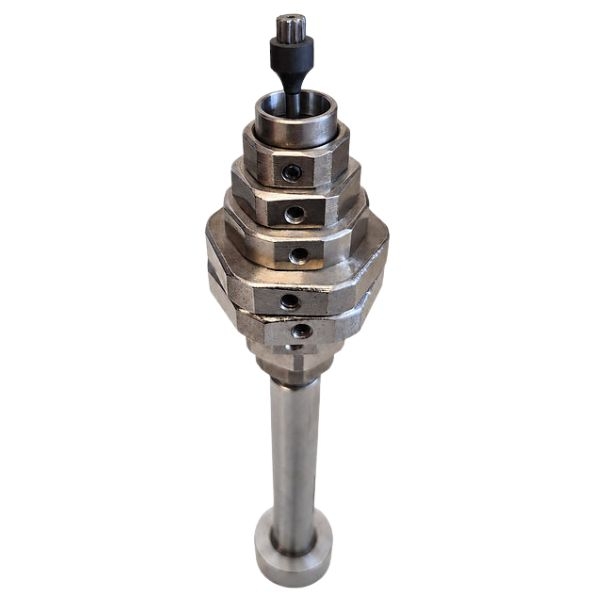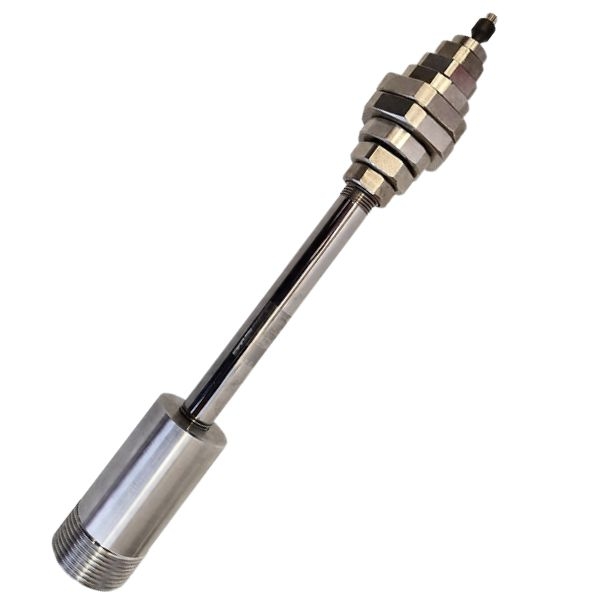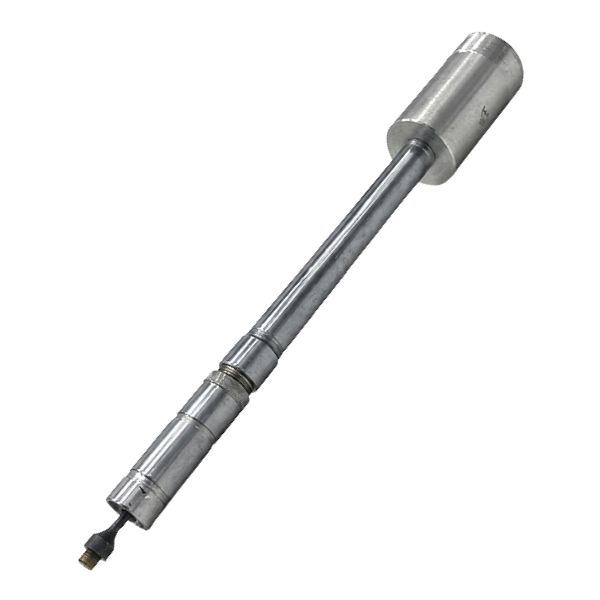
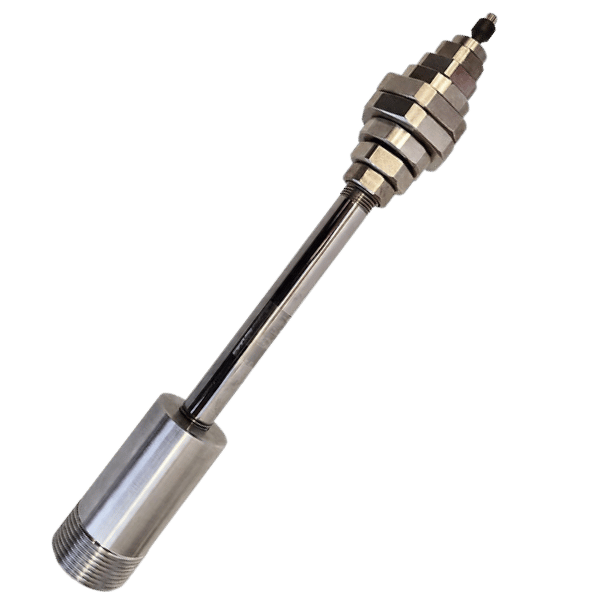


The solution is designed to remove rust, oxidation, residues and old coatings from hard-to-reach areas, preparing the internal walls of pipes for subsequent painting or anti-corrosion protection. The supplied centring collars help keep the nozzle in the correct position for the specified diameters.
Main benefits
360° blasting jet
Treats the entire internal circumference with a single controlled longitudinal pass.
Access to small diameters
Works inside pipes from 19 to 50 mm, where a conventional blasting gun cannot be correctly oriented.
More accurate centring
Dedicated collars help maintain a consistent distance from the internal walls.
Uniform surface preparation
Helps achieve a more consistent surface before applying primers, paints or protective coatings.
Professional configuration
6 mm nozzle and clearly specified indicative air consumption make it easier to size the compressed-air system correctly.
Fewer manual operations
There is no need to aim the jet separately at each section of the internal circumference.
AT A GLANCE Internal diameters 19–50 mm | 360° radial jet | 6 mm nozzle | Indicative air consumption 2.26 m³/min | Centring collars included.
What is HOLLOBLAST MINI?
HOLLOBLAST MINI replaces the standard terminal nozzle in a blasting configuration designed specifically for the inside of pipes. It is connected to the abrasive hose by means of a nozzle holder with an internal thread, which must be sized according to the outside diameter of the abrasive hose being used.
The air-abrasive mixture reaches the deflection device and is distributed radially onto the internal walls. By moving the accessory along the pipe axis at a controlled speed, the circular jet progressively treats the entire accessible length.
Why internal pipe blasting requires a specific accessory
The inside of a pipe is a confined surface that is difficult to inspect visually. A straight nozzle concentrates the jet forwards and cannot consistently reach the entire circumference. This can leave areas insufficiently treated, especially when the diameter is too small to allow the blasting gun to be manually oriented.
HOLLOBLAST MINI transforms the forward jet into a 360° circular blasting pattern. The practical advantage is not simply reaching the internal wall, but maintaining a more consistent action around the entire internal circumference, provided that centring, pressure, abrasive and travel speed are correctly adjusted.
How 360° blasting works
- Connection: the accessory is connected to the abrasive hose using the appropriate nozzle holder.
- Supply: the blasting machine delivers the compressed-air and abrasive mixture towards the 6 mm nozzle.
- Radial deflection: the jet is distributed through 360° against the internal wall of the pipe.
- Centring: the collar corresponding to the pipe diameter helps limit misalignment of the accessory.
- Controlled movement: the operator moves the system along the pipe at a speed consistent with the required removal level and surface profile.
- Final inspection: treatment uniformity is checked before proceeding with the protective coating cycle.
Which materials and contaminants can be removed
On metal pipes, HOLLOBLAST MINI can be used to remove rust, oxidation, adhering residues and deteriorated coatings. Actual performance depends on the abrasive type, particle size, available pressure, thickness of the material being removed and travel speed.
Blasting can also create the surface profile required for a subsequent coating. However, the required preparation grade and final roughness must be defined according to the coating-system specification and verified using the inspection instruments required by the process.
Operating benefits of HOLLOBLAST MINI
Complete treatment of the internal circumference
The radial jet reaches the entire internal perimeter simultaneously. This reduces the need to repeatedly rotate or redirect a conventional nozzle and makes movement along the pipe more straightforward.
Dedicated centring for each specified diameter
The collars keep the accessory closer to the pipe axis. A more consistent distance between nozzle and wall helps achieve a more uniform treatment and limits significant differences between one side and the other.
More consistent preparation before protection
Removing corrosion and old residues evenly improves the starting conditions for primers and protective coatings. The final quality always depends on the complete process: blasting, inspection, removal of residual dust and application within the specified time.
Clearly defined compressed-air requirements
The indicative value of 2.26 m³/min with a new 6 mm nozzle makes it possible to check in advance whether the compressor can sustain the operation. Line losses, hose length and diameter, air quality and the operating margin of the system should also be taken into account.
Recommended applications
- Internal preparation of metal pipes before painting or anti-corrosion treatment.
- Removal of oxidation and residues during industrial maintenance operations.
- Reconditioning of pipes, pipe sections, sleeves and straight cylindrical components.
- Operations in metal-fabrication workshops, mechanical workshops and companies that manufacture or restore tubular components.
- Preparation of small pipes for plants, metal structures and components requiring subsequent protective treatments.
Centring collars included
| Internal pipe diameter | Centring configuration |
|---|---|
| 19 mm | Used without collar |
| 26 mm | 25.5 mm collar |
| 32 mm | 31.5 mm collar |
| 38 mm | 36.5 mm collar |
| 50 mm | 47.5 mm collar |
How to achieve a uniform result
- Measure the actual internal diameter: deposits, ovality or tolerances may change the available clearance.
- Select the correct collar: the system must move freely without becoming jammed while remaining sufficiently centred.
- Use clean, dry air: moisture and condensate can compromise abrasive flow and cause blockages.
- Select the abrasive with FEVI: type and particle size must be compatible with the nozzle, pipe material and required surface profile.
- Maintain a consistent travel speed: moving too quickly can leave areas insufficiently treated, while moving too slowly can increase aggressiveness and abrasive consumption.
- Carry out a preliminary test: test on a sample or controllable section, checking removal and roughness before production.
Compatibility and safety
HOLLOBLAST MINI must be incorporated into a professional configuration compatible with the required airflow, abrasive hose, nozzle holder and abrasive being used. It should not be considered automatically compatible with every blasting machine without a technical assessment.
The accessory does not itself include an abrasive extraction or recovery system. The operation must therefore be organised in an area suitable for blasting, with containment of dust and material expelled from the ends of the pipe, suitable protective equipment and procedures consistent with the company's risk assessment.
Before working on previously used pipes, it is essential to ensure that they are out of service, isolated, depressurised and free from flammable, explosive, toxic substances or materials incompatible with blasting. Tight bends, fittings, changes in cross-section and internal obstructions require a specific assessment.
Frequently asked questions about HOLLOBLAST MINI
1. Which pipe diameters is HOLLOBLAST MINI designed for?
View answer
It is designed for pipes with an internal diameter between 19 and 50 mm. The stated diameters refer to the actual available internal clearance, which must be measured before configuration.
2. Does the jet really reach the entire internal circumference?
View answer
Yes. The device radially deflects the air-abrasive mixture through 360°. Final uniformity also depends on correct centring, pressure, abrasive and consistent longitudinal movement.
3. Which compressor is required?
View answer
Indicative air consumption is 2.26 m³/min with a new 6 mm nozzle. The compressor must supply this airflow under actual operating conditions, taking into account line losses and an adequate operating margin for continuous use.
4. Are the centring collars included?
View answer
Yes. The standard equipment includes collars for internal diameters of 26, 32, 38 and 50 mm; for a 19 mm pipe, the accessory is used without a collar.
5. Which abrasive should be used?
View answer
The choice depends on the metal, contamination, required removal level and surface profile. The abrasive must be dry and have a particle size compatible with the system; FEVI can check the configuration before use.
6. Can it remove rust and old paint?
View answer
Yes, it can remove rust, oxidation, residues and deteriorated coatings. Processing time and final result vary according to coating thickness, adhesion and blasting parameters.
7. Can it work inside curved pipes?
View answer
It is primarily designed for straight sections with a regular cross-section. Bends, elbows, protruding welds or changes in diameter may obstruct passage and must be assessed before the operation.
8. Can it be connected to any blasting machine?
View answer
Not automatically. A suitable professional blasting machine, compatible abrasive hose, nozzle holder with the correct internal thread and sufficient airflow are required. FEVI can verify the complete configuration.
9. Does HOLLOBLAST MINI recover the abrasive and dust?
View answer
No. The accessory distributes the blasting jet inside the pipe but does not include a recovery system. Containment, extraction and collection must be designed according to the working environment.