Compressors | FEVI
FEVI sandblasting compressors include piston and screw solutions designed to power sandblasting equipment in workshops and industrial environments. The right choice depends on the required air flow rate, operating pressure, and duty cycle duration. Compare models while considering electrical supply, moisture management, and airline characteristics: a properly matched compressor ensures a steady blast stream during operation.
Read more
How to Choose a Compressor for Sandblasting
Start with the sandblasting machine you need to power and its air consumption at the working pressure. Nozzle size and operating conditions determine overall demand: as nozzle diameter increases—including through wear—air demand rises. Additionally, factor in other pneumatic tools operating simultaneously. Selecting a compressor based solely on horsepower can lead to underpowered performance.
Free Air Delivery (FAD) and Operating Pressure
Properly sizing a compressor for sandblasting requires assessing Free Air Delivery (FAD) at the working pressure, typically measured in liters per minute (L/min) or CFM. Displacement figures alone do not reflect actual output. Always compare ratings measured under identical test conditions, and verify delivered pressure at the nozzle: hoses, fittings, and filters cause pressure drops that tank gauges alone will not show.
Piston vs. Rotary Screw Compressors
Choosing between piston and rotary screw models depends on duty cycle length and planned rest intervals. For continuous industrial operations, rotary screw compressors engineered for continuous duty are recommended. When using piston units, respect the manufacturer's recommended duty cycle. Also verify available electrical supply, current draw, and starting requirements.
Clean, Dry Air and Moisture Management
Moisture in compressed air lines causes abrasive clumping and erratic blast flow. Refrigerant dryers, water separators, and inline filters perform distinct functions and must be sized according to air flow, pressure, and ambient conditions. CPR DRY models feature an integrated dryer; for other configurations, air treatment options must be specified. Ensure automatic drains remain fully functional and inspect filter elements regularly.
FEVI Product Range Overview
| Model or Series | Technology and Configuration |
|---|---|
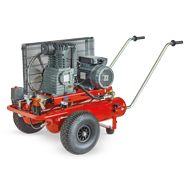
| TT22 | Single-stage belt-driven piston compressor, 2.2 kW single-phase motor, portable wheeled frame with handles. |
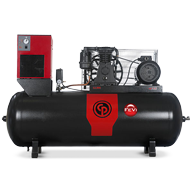
| CPR 7.5 HP DRY | Two-stage belt-driven piston compressor with integrated dryer, stationary tank-mounted configuration. |
| CPR 10 HP DRY | Two-stage belt-driven piston compressor with integrated dryer, stationary tank-mounted configuration. |
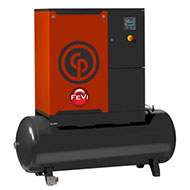
| CPA & CPB | Oil-injected rotary screw series with three-phase motor. Air receiver and treatment packages configured per application. |
The specifications above serve as a general selection guide; final compressor selection requires matching Free Air Delivery (FAD) and duty cycle to your specific sandblaster.
Frequently Asked Questions About Sandblasting Compressors
How many liters per minute (L/min) are needed for sandblasting?
Required air flow depends on the sandblaster model, nozzle orifice size, and operating pressure. Compare the sandblaster's specified air consumption against the compressor's Free Air Delivery (FAD) at operating pressure, adding capacity for any simultaneous air tools.
Does a larger air receiver tank allow continuous sandblasting?
An air receiver stores compressed air, but it does not increase air production. If air consumption exceeds FAD, line pressure will drop regardless of tank size. Continuous work requires adequate real-time air generation capacity.
When should I consider a diesel/engine-driven compressor?
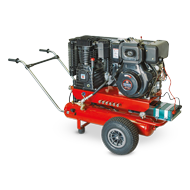
When working on sites without an adequate electrical power supply, consider an engine-driven compressor sized for the required FAD and job-site conditions. Verify power needs for auxiliary equipment, including air dryers, separately.
For mobile and outdoor operations, explore FEVI engine-driven compressors.
Find the Right Compressor for Your Sandblaster
Send FEVI your sandblaster model, nozzle diameter, working pressure, shift duration, available power supply, and hose length. Our engineering team will evaluate your technical setup to recommend the optimal compressor and air treatment package.
REQUEST COMPRESSOR EVALUATION BROWSE COMPRESSORS ON FEVI STORE