Internal pipe blasting requires a jet capable of reaching the entire circumference and maintaining consistent action while moving along the pipe. HOLLOBLAST MINI and HOLLOBLAST MAX are professional FEVI accessories that transform the axial jet into a 360° radial distribution. The MINI model is designed for internal diameters from 19 to 50 mm, while the MAX model operates on diameters from 130 to 300 mm using an inverted-cone nozzle and an adjustable centring carriage.
Treating the outside of a pipe allows the operator to observe the surface directly, aim the blasting gun and correct the pass as required. Inside a pipe, however, the surface is confined, difficult to see and often inaccessible with a conventional blasting gun. A straight nozzle concentrates the jet directly ahead, but does not make it easy to maintain the same action around the entire internal circumference.
The result may be uneven surface preparation: some areas receive sufficient abrasive action, while others retain oxidation, mill scale, residues or parts of the old coating. This inconsistency becomes particularly critical when the internal wall must subsequently receive a primer, paint or anti-corrosion protection. The quality of the following coating cycle also depends on the consistency of the prepared surface.
To meet this requirement, FEVI offers two different configurations. HOLLOBLAST MINI can enter small-diameter pipes where manually directing the jet is not practical. HOLLOBLAST MAX is designed for larger-diameter pipes and uses an adjustable carriage to support the assembly and stabilise its movement. In both cases, the objective is to turn internal pipe blasting into a more controllable, repeatable process that is consistent with the required result.
What is internal pipe blasting?
Internal pipe blasting is an abrasive process carried out on the internal walls of a pipe to remove rust, oxidation, mill scale, processing residues or deteriorated coatings. The process can also create the surface profile required for subsequent painting or anti-corrosion protection, which must be verified according to the specifications of the coating system being applied.
The principle is not simply to insert a conventional nozzle into the pipe. To obtain a consistent result, the air-abrasive mixture must be directed towards the internal wall, the device must remain close to the pipe axis and its longitudinal movement must be controlled. Actual diameter, geometry, abrasive, pressure, airflow and travel speed all contribute to the final result.
Why internal pipe preparation is complex
A confined surface that is difficult to monitor
The operator cannot continuously observe the point where the jet impacts the surface. Verification must therefore be based on a defined configuration, an initial test and a final inspection of the achieved removal grade and surface roughness.
The distance from the wall must remain consistent
If the device is off-centre, the jet operates closer to one side and further away from the opposite side. Even with 360° distribution, an inconsistent distance can produce differences around the circumference. This is why the centring collars used with the MINI and the carriage used with the MAX play a key operating role.
Travel speed influences the preparation grade
Moving too quickly can leave residues or insufficiently treated areas. Moving too slowly can increase aggressiveness, abrasive consumption, roughness and component wear. Travel speed must therefore be validated on the actual material and kept as consistent as possible.
The nominal diameter is not always the available diameter
Deposits, ovality, protruding welds, tolerances and restrictions can reduce the actual clearance. Selection of the accessory must therefore start from measurements of the actual internal diameter at several points, not simply from the nominal pipe size.
How a 360° system works for internal pipe blasting
The professional blasting machine sends the compressed-air and abrasive mixture through the abrasive hose. Instead of continuing as a forward-facing jet, the terminal device deflects the mixture radially against the internal wall. The jet therefore reaches the entire circumference while the accessory moves longitudinally through the pipe.
The operating sequence normally includes:
- checking the geometry and actual internal diameter;
- selecting the model and configuring the centring system;
- connecting the accessory to a compatible abrasive line;
- checking airflow and abrasive condition;
- testing movement through the pipe with the system switched off;
- moving the accessory forwards or pulling it back at a controlled speed;
- checking the removal grade and resulting surface profile.
The 360° jet reduces the need to repeatedly direct the nozzle towards different sections of the internal wall and makes it possible to treat the entire circumference without rotating the pipe during the pass. It does not, however, make the result automatic: centring, operating parameters and travel speed must all be set correctly.
HOLLOBLAST MINI: internal pipe blasting from 19 to 50 mm
HOLLOBLAST MINI is designed for pipes with internal diameters from 19 to 50 mm. The device uses a 6 mm nozzle and distributes the air-abrasive mixture radially through 360°, making it possible to treat diameters in which a conventional blasting gun could not be correctly oriented.
The stated indicative air consumption is 2.26 m³/min with a new 6 mm nozzle. This value makes it possible to check in advance whether the compressor and air line can sustain the operation. Pressure losses, air-line length and diameter, compressed-air quality and an adequate operating margin must also be taken into account. Nozzle wear can progressively increase the required airflow.
Dedicated centring collars
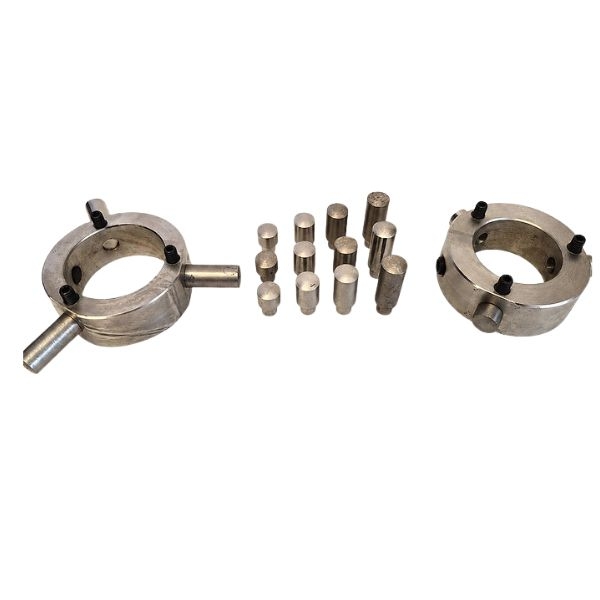
The standard equipment includes collars that help keep the accessory close to the pipe axis. The specified configuration is:
- pipe with 19 mm internal diameter: used without collar;
- 26 mm pipe: 25.5 mm collar;
- 32 mm pipe: 31.5 mm collar;
- 38 mm pipe: 36.5 mm collar;
- 50 mm pipe: 47.5 mm collar.
The collar must allow the device to move smoothly without becoming jammed while maintaining sufficient centring. Before blasting, it is therefore advisable to carry out a movement test over the entire accessible length.
Benefits for small diameters
The main advantage of the MINI model is accessibility. The radial jet reaches the entire internal perimeter simultaneously and makes movement along the pipe more straightforward. A more consistent distance from the walls helps achieve uniform preparation before primers or coatings are applied and reduces the need for difficult-to-control manual aiming.
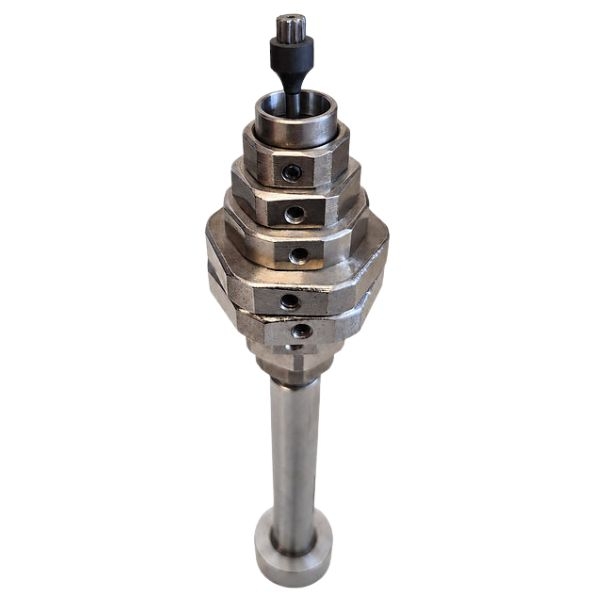
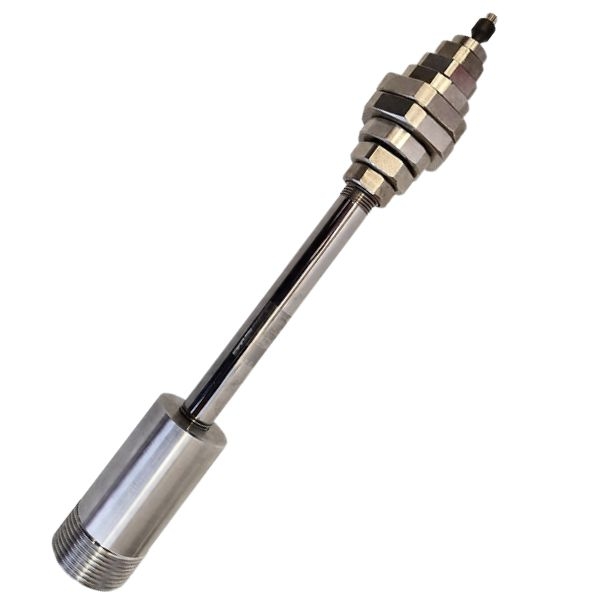
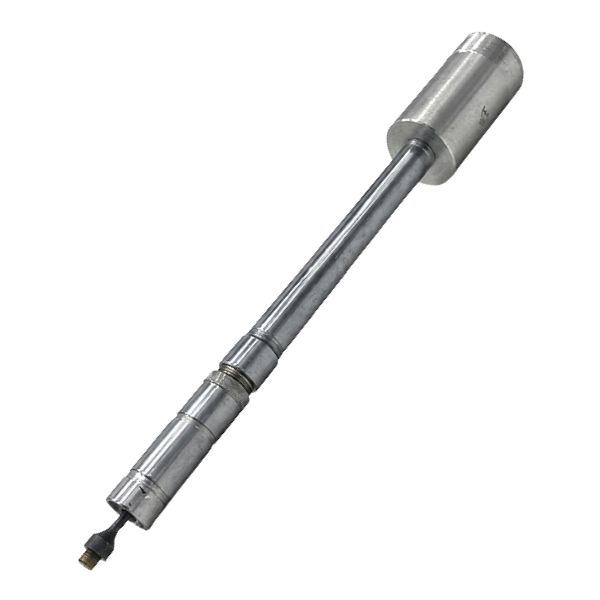
HOLLOBLAST MAX: internal pipe blasting from 130 to 300 mm
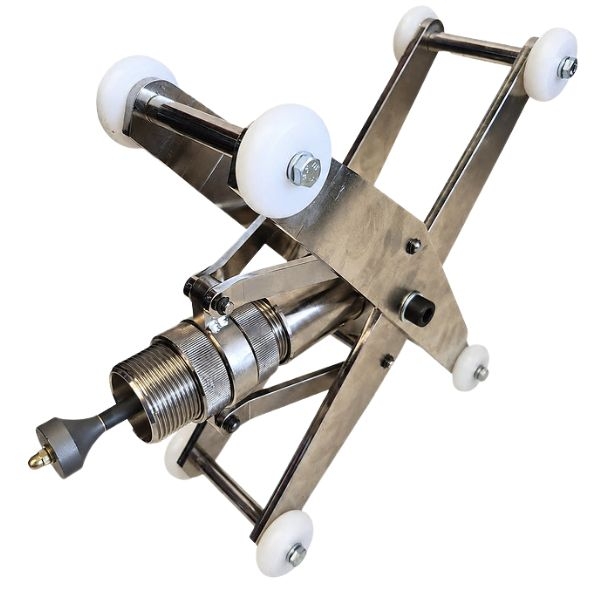
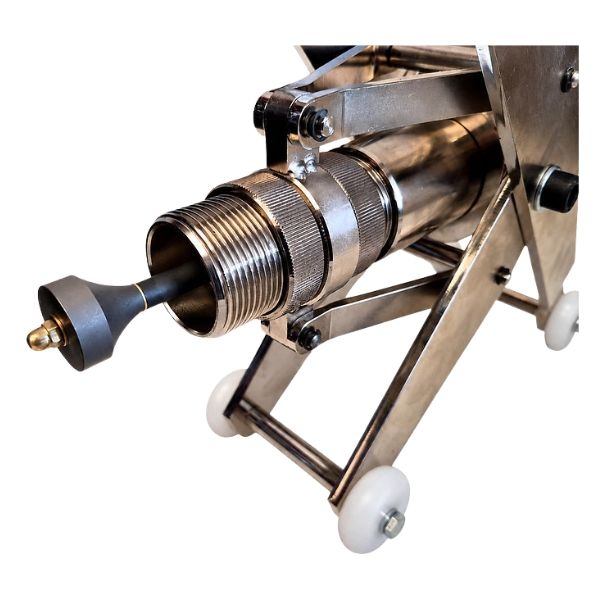
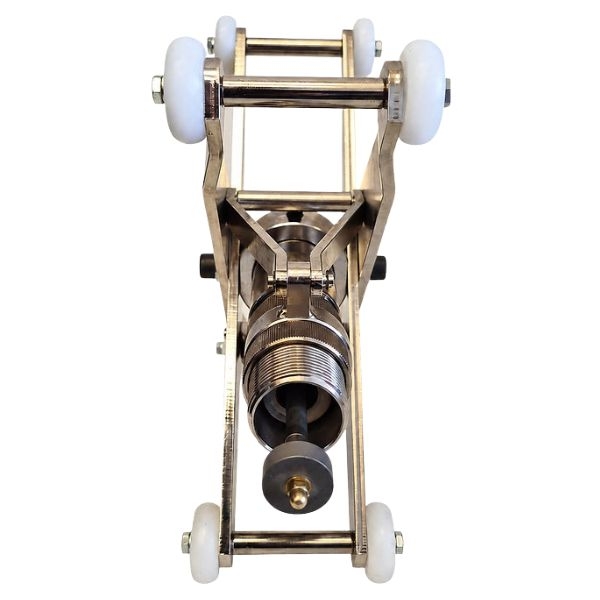
HOLLOBLAST MAX is designed for metal pipes with internal diameters from 130 to 300 mm. The accessory connects to a professional pressure blasting machine and uses an inverted-cone nozzle: the air-abrasive mixture is intercepted and deflected radially around the entire circumference.
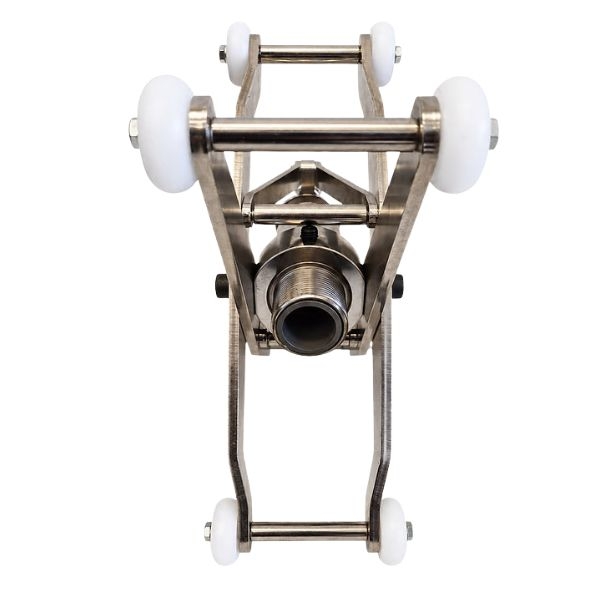
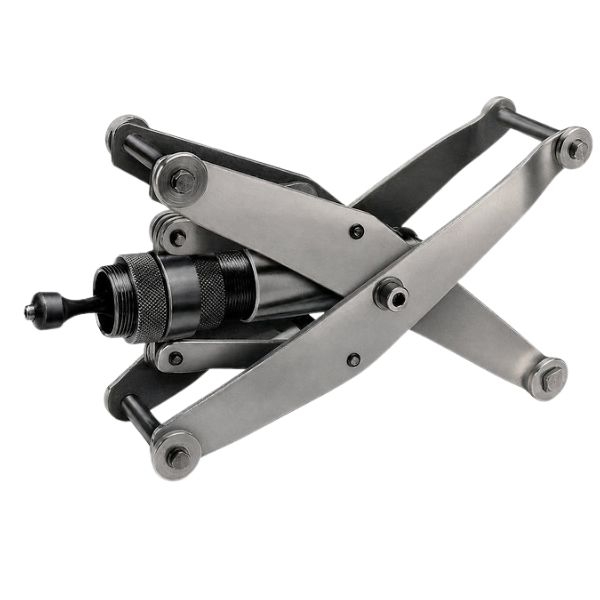
The adjustable centring carriage, included in the configuration, supports the assembly and keeps the cone closer to the pipe axis. The wheels facilitate forward or return movement along straight sections and help maintain a more consistent distance from the wall. This benefit is particularly important with heavy pipes or pipes that are difficult to rotate, because the circular coverage allows the entire perimeter to be treated using longitudinal movement alone.
Why the adjustable carriage is important
An off-centre nozzle can create differences in intensity between one side and the other. By adjusting the carriage to the actual internal diameter, the device maintains a more stable position and reduces oscillation or irregular contact. Before starting, the wheels must be adjusted and tested with the system switched off, checking for welds, restrictions or obstructions.
Parameters to be sized according to the application
For the MAX model, the airflow requirement cannot be defined by a single value: it depends on the actual nozzle diameter, operating pressure, abrasive and line losses. The compressor and blasting machine must therefore be sized after the complete configuration has been defined. Wear of the nozzle and inverted cone must also be checked periodically.
Which model should you choose?
| Feature | MINI | MAX |
|---|---|---|
| Internal pipe diameter | 19–50 mm | 130–300 mm |
| Jet distribution | 360° radial | 360° radial |
| Jet distribution system | 6 mm nozzle | Inverted-cone nozzle |
| Centring | Dedicated collars included | Adjustable centring carriage included |
| Operating movement | Controlled longitudinal pass | Forward or return longitudinal movement on wheels |
| Supply system | Compatible professional configuration | Professional pressure blasting machine |
| Application advantage | Access to small diameters | Greater stability in larger diameters |
Selection starts with the actual internal diameter but does not end with this measurement. Pipe length, straightness, bends or welds, pipe material, contamination to be removed, required final profile, abrasive and available equipment must also be considered. The two standard models cover 19–50 mm and 130–300 mm. For intermediate diameters or special conditions, a FEVI technical assessment is required rather than assuming that either standard configuration will be compatible.
Operating benefits of the HOLLOBLAST solution
- Full circumference coverage: the radial jet reaches the internal perimeter during the longitudinal pass.
- Dedicated centring: collars and carriage help maintain a more consistent distance from the wall.
- No pipe rotation during the pass: a practical advantage when the component is heavy, long or difficult to handle.
- Greater repeatability: once abrasive, pressure, speed and number of passes are defined, the process becomes more controllable.
- More uniform preparation: a consistent surface provides better starting conditions for primers and protective coatings.
- Fewer manual corrections: the jet does not need to be separately directed towards different sections of the circumference.
These benefits do not depend on the accessory alone. Final quality results from the complete combination of blasting machine, compressor, dry air, abrasive, centring, movement and result inspection.
Sectors and applications
The systems can be evaluated for the internal preparation of metal pipes before painting or anti-corrosion protection, for the removal of oxidation and mill scale, for reconditioning sleeves and cylindrical components, and for operations performed by metal-fabrication companies, mechanical workshops and industrial maintenance companies.
Other potential fields include plant construction, metalworking, energy, infrastructure and marine applications, always after checking geometry, existing residues and process specifications. The devices are primarily intended for straight, regular sections. Tight bends, elbows, internal flanges, changes in cross-section or protruding weld beads may prevent passage.
How to prepare the operation correctly
Before starting, it is advisable to:
- measure the internal diameter at several points;
- identify ovality, deposits, welds and restrictions;
- select and test the centring system;
- check compatibility between the blasting machine, abrasive hose and nozzle holder;
- size the compressor and line according to actual operating conditions;
- select the abrasive type and particle size according to the material and required profile;
- use clean, dry compressed air;
- carry out a test on a sample section;
- define a consistent travel speed;
- check the removal grade and surface roughness before applying the protective coating cycle.
The accessory does not automatically include abrasive recovery or dust extraction. The operation must therefore take place in a suitable area, with containment of materials expelled from the pipe ends, appropriate protective equipment and procedures consistent with the risk assessment. Previously used pipes must be isolated, depressurised and verified as being free from flammable, explosive, toxic substances or materials incompatible with blasting.
Mistakes to avoid
The first mistake is selecting the model based only on the nominal diameter. It is equally risky to ignore bends, obstructions or reductions in cross-section, use damp or incompatible abrasive, work with an undersized compressor or proceed without a preliminary test.
Even a 360° jet can produce uneven results if the accessory is off-centre or moves at an inconsistent speed. Finally, neglecting wear of the nozzle and deflection cone changes both the airflow requirement and the action of the jet.
Recording effective parameters makes it possible to repeat the operation with greater consistency.
Two application examples
Small straight pipes
A workshop needs to remove internal oxidation from metal pipes with an actual internal clearance of 32 mm before applying a protective coating cycle. After checking straightness and confirming the absence of obstructions, the MINI model is configured with the 31.5 mm collar, available airflow is checked and both abrasive and travel speed are validated on a sample. The key parameter is not simply visible removal, but consistency of the result around the entire circumference.
Larger-diameter pipe
A company needs to prepare a straight pipe section with an internal diameter of 200 mm. The MAX model is adjusted using the centring carriage and tested along the pipe with the system switched off. The process is carried out by pulling the assembly back at a controlled speed without rotating the pipe. After the first pass, removal and surface profile are checked before confirming the parameters for subsequent components.
Why request a technical assessment from FEVI?
Internal pipe blasting cannot be addressed simply by selecting an accessory in isolation. FEVI starts by understanding the requirement, analysing the pipe, residue, required result and available equipment, and then verifies the most suitable configuration. This approach makes it possible to address airflow, abrasive, connections, centring, movement and management of the working area in advance.
Providing the internal diameter, length, material, geometry, contamination and photographs makes the assessment faster and more practical. For diameters outside the two standard configurations or for pipes with bends and obstructions, a preliminary assessment is essential.
Frequently asked questions about internal pipe blasting
What is internal pipe blasting?
It is an abrasive process carried out on the internal walls of a pipe to remove rust, oxidation, mill scale, residues or old coatings and, where required, create a surface profile suitable for a subsequent protective coating cycle. A dedicated accessory deflects the jet towards the internal wall and is moved along the pipe axis at a controlled speed.
How can the inside of a pipe be blasted uniformly?
The jet must be distributed around the entire circumference, the device must remain centred and forward or return speed must be controlled. Uniformity also depends on pressure, abrasive, airflow, component wear and initial conditions. A preliminary test and final inspection remain essential.
What is the difference between HOLLOBLAST MINI and HOLLOBLAST MAX?
HOLLOBLAST MINI operates on internal diameters from 19 to 50 mm and uses a 6 mm nozzle with dedicated centring collars. HOLLOBLAST MAX is designed for diameters from 130 to 300 mm and uses an inverted cone with an adjustable centring carriage.
How do I select the model according to the internal diameter?
The actual internal clearance must be measured at several points, taking into account deposits, ovality, welds and restrictions. The MINI model covers 19–50 mm and the MAX covers 130–300 mm. For intermediate diameters or special geometries, a standard configuration should not be forced: a FEVI technical assessment is required.
Does the abrasive jet reach the entire pipe circumference?
Yes. Both devices distribute the air-abrasive mixture radially through 360°. This allows the entire internal perimeter to be treated during longitudinal movement. The 360° coverage promotes uniformity, but the final result also depends on centring, speed, pressure, abrasive and nozzle wear.
Which residues can be removed?
On metal pipes, the systems can be used to remove rust, oxidation, mill scale, adhering residues and deteriorated coatings. The removal grade depends on the thickness and adhesion of the material, abrasive type and particle size, available pressure and travel speed. The result must be checked against the specifications of the subsequent coating cycle.
Which abrasive should be used?
There is no single abrasive suitable for every application. Selection depends on the pipe material, residue to be removed, required surface profile and compatibility with the nozzle and deflection system. The abrasive must be dry and have a suitable particle size; FEVI can verify its suitability before use.
What compressor specifications are required?
For the MINI model, indicative consumption is 2.26 m³/min with a new 6 mm nozzle. For the MAX model, airflow depends on the actual configuration. In both cases, actual pressure at the working point, line losses, continuous air supply, air quality and increased consumption due to wear must be considered.
Can the systems operate inside curved pipes?
They are primarily designed for straight sections with a regular cross-section. Bends, elbows, flanges, protruding welds, changes in diameter and obstructions may prevent movement or compromise centring. Before blasting, the geometry must be checked and movement of the accessory tested with the system switched off.
Do the systems automatically recover abrasive and dust?
No. The accessories distribute the jet inside the pipe but do not automatically integrate extraction or abrasive recovery. Containment, any required extraction and abrasive collection must be designed according to the pipe and working area, with suitable operator protection.
Final technical considerations: turning a test into a repeatable process
For recurring operations, it is useful to create a process sheet. The sheet can record actual diameter, abrasive, pressure, travel speed, number of passes, nozzle condition and measured result. Photographing the initial and final condition helps compare components and identify any variations.
It is also advisable to inspect the result at several points and around the entire circumference rather than limiting checks to the easily visible pipe ends. When the pipe is to receive a coating, inspection must be consistent with the specifications of the protective coating cycle and with the permitted time between surface preparation and application.
Ask FEVI to configure the solution for your pipe
To assess the most suitable solution, provide FEVI with the actual internal diameter, pipe length and material, the presence of bends or obstructions, the residue or coating to be removed and the required final result. Also indicate any blasting machine and compressor already available: this information allows the model, abrasive, airflow, connections and movement method to be checked before the operation.