
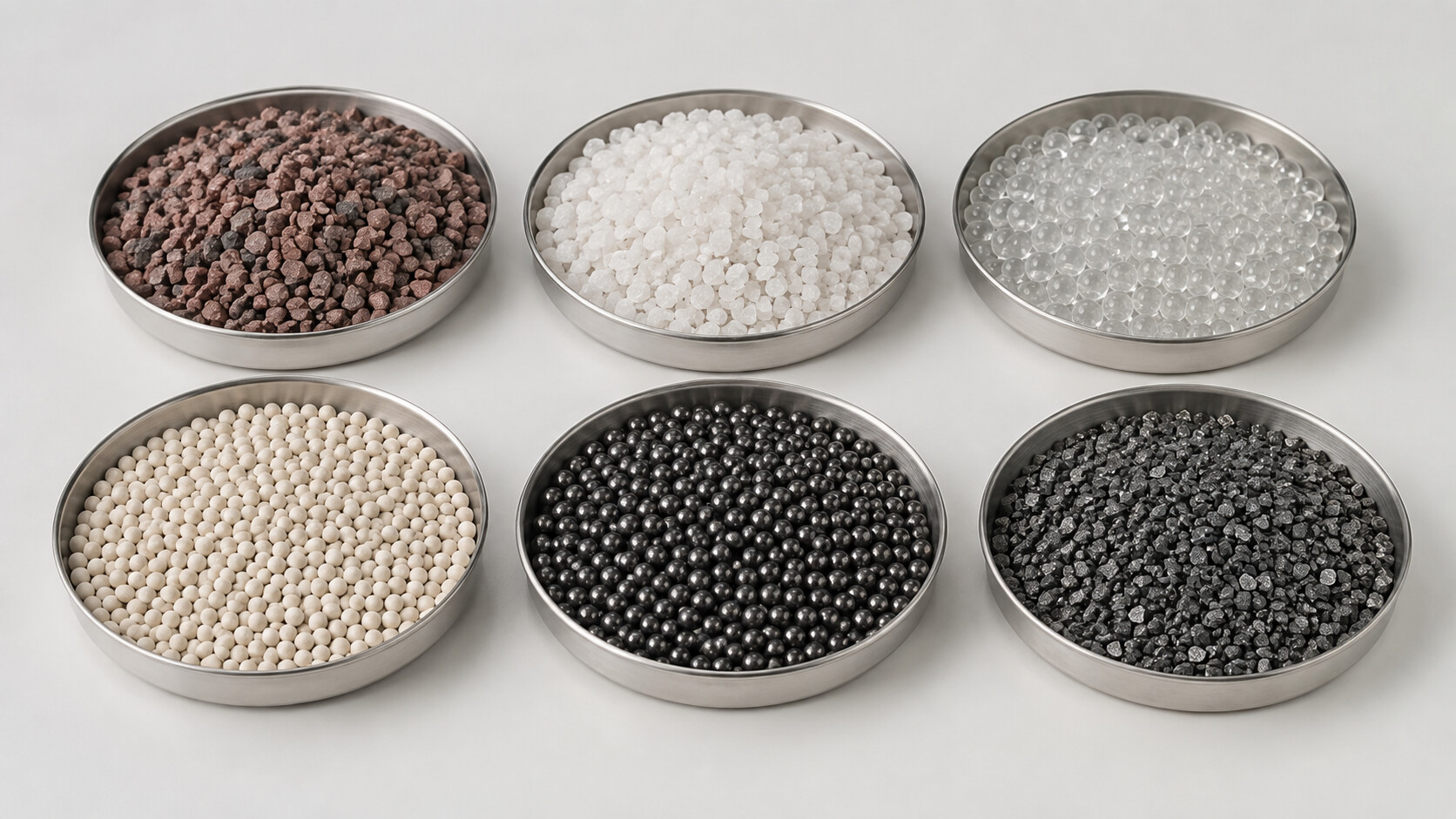
Corundum is an angular abrasive with a high cutting capacity: brown fused alumina is tough and versatile, while white fused alumina is mainly selected when high purity and the absence of ferrous contamination are required. Glass and ceramic beads are spherical and are more suitable for uniform finishes, satin finishing and controlled surface treatment. Steel beads, more commonly referred to as steel shot, transfer a high level of impact energy and are used mainly in closed systems and shot-blasting machines. Angular steel grit, on the other hand, provides a more pronounced cutting action and creates an anchor profile.
Price should not be compared only per kilogram or per bag. The correct choice depends on shape, particle size, density, service life, recovery potential, machine wear and the required result. An abrasive with a higher initial price may prove more economical if it maintains its characteristics for longer and can be efficiently separated and reused in a suitable system.
Corundum, beads and grit are not the same “sand”
In everyday language, the expression “sand for a blasting machine” is often used for any material projected by the blasting jet. From a technical point of view, however, corundum, beads and grit differ in composition, shape and behaviour.
The first distinction concerns particle geometry:
- an angular abrasive has sharp edges that cut into the surface, remove coatings and generate roughness;
- a spherical abrasive works mainly by impact, produces a more uniform appearance and provides a less aggressive finish;
- density and particle size determine the energy transferred and must be compatible with the blasting system;
- toughness and friability influence service life, dust generation and recovery potential.
For this reason, there is no single best abrasive. There is only the abrasive that is most suitable for the substrate, the required removal, the required finish and the available machine.
What is corundum for sandblasting?
Corundum used for abrasive blasting is an aluminium-oxide-based abrasive. Its hard, angular structure provides a strong cutting action, useful for removing rust, oxides, mill scale, paint and resistant residues or for creating controlled roughness before painting, PTFE coating or the application of other coatings.
Selection is not limited to the name of the material. Particle size must also be defined, because a coarser grade generally produces a stronger action and a more pronounced profile, while a finer grade provides greater control and a more uniform finish. Pressure, distance, working angle and airflow further influence the result.
Brown fused alumina: characteristics and applications
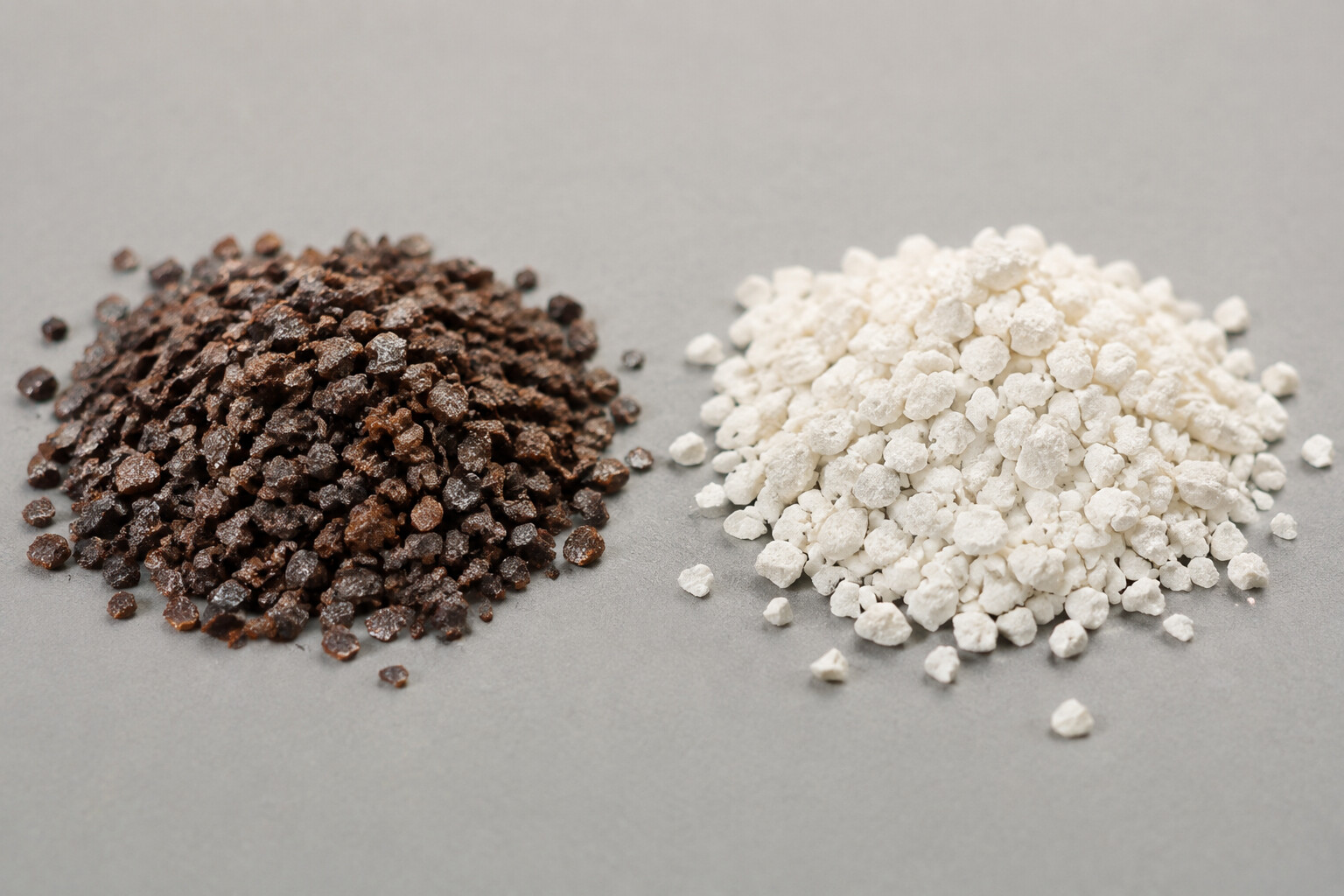
Brown fused alumina is a crystalline aluminium oxide characterised by high hardness and good toughness. Its angular shape provides rapid abrasive action, making it suitable when strong removal is required or when a surface must be prepared for a subsequent treatment.
Typical applications include:
- removal of rust, oxides, mill scale and old coatings;
- deburring and finishing of castings;
- roughening before painting, plastic coating, PTFE coating or rubber coating;
- treatment of iron, steel and other compatible materials;
- blasting in systems equipped with abrasive recovery and effective dust separation.
FEVI offers Coriblast brown fused alumina, available in particle sizes selected according to the required result and blasting machine.
White fused alumina: when is it preferable?
White fused alumina is produced from high-purity alumina and is a non-ferrous abrasive. It is considered when the process must avoid introducing ferrous particles onto the surface, for example on stainless steel, non-ferrous alloys, glass, plastics or components intended for specialist applications.
It remains a hard, angular abrasive and should therefore not be confused with glass beads simply because both can be used on materials sensitive to ferrous contamination. White fused alumina cuts and creates a surface profile; spherical glass beads tend instead to even out and satin-finish the surface.
Before selecting white fused alumina, it is advisable to check:
- compatibility with the material being treated;
- the required final roughness;
- particle size permitted by the nozzle and metering system;
- the possibility of recovery without cross-contamination;
- the cleanliness of the cabinet, hoses and recycling system.
Brown fused alumina or white fused alumina?
| Criterion | Brown fused alumina | White fused alumina |
|---|---|---|
| Shape | Angular | Angular |
| Primary action | Strong removal and cutting action | Controlled cutting action with high purity |
| Typical application | Iron, steel, rust, oxides, coatings | Stainless steel, non-ferrous alloys, glass and contamination-sensitive applications |
| Surface profile | Pronounced and adjustable through particle size | Pronounced but better suited to applications requiring the absence of ferrous residues |
| Priority choice when | Toughness, cutting capacity and versatility are important | Purity and prevention of ferrous contamination are important |
| Checks required | Particle size, nozzle, recovery and finish | Circuit cleanliness, cross-contamination, particle size and finish |
Corundum price: how much does it really cost?
Users searching for “corundum price” generally want an immediate figure. A comparison is useful only when it considers the same type of corundum, the same particle size, the actual package weight, transport costs and operating conditions.
At the date of this article update, 28 August 2026, Coriblast grade 40 brown fused alumina is offered on FEVI Store at EUR 76.00 + VAT for 25 kg, on promotion from the stated regular price of EUR 95.00 + VAT. Prices may change, so it is always advisable to check the current Coriblast corundum price on FEVI Store.
The price of the bag, however, is not the actual process cost. When comparing two abrasives, it is necessary to assess:
- price per kilogram, avoiding confusion between packages expressed in litres and kilograms;
- quantity consumed to achieve the required result;
- number of reuse cycles actually achievable;
- percentage of abrasive separated and recovered by the system;
- wear generated on the nozzle, gun, valves, hoses and recovery system;
- amount of dust generated and filter loading;
- processing, handling and disposal time.
Coriblast brown fused alumina for sandblasting
Available on FEVI Store in professional 25 kg bags with selected particle sizes for demanding removal operations, paint stripping and the creation of an anchor profile.
Blasting beads: glass, ceramic or steel?
Beads are spherical or rounded blasting media. Compared with corundum and angular grit, they provide less cutting action and work mainly through impact. They are suitable when the objective is to create a uniform surface appearance, obtain a satin finish or perform controlled removal without producing an excessive surface profile.
The composition, however, significantly changes density, durability, impact energy, contamination risk and machine compatibility.
Glass beads
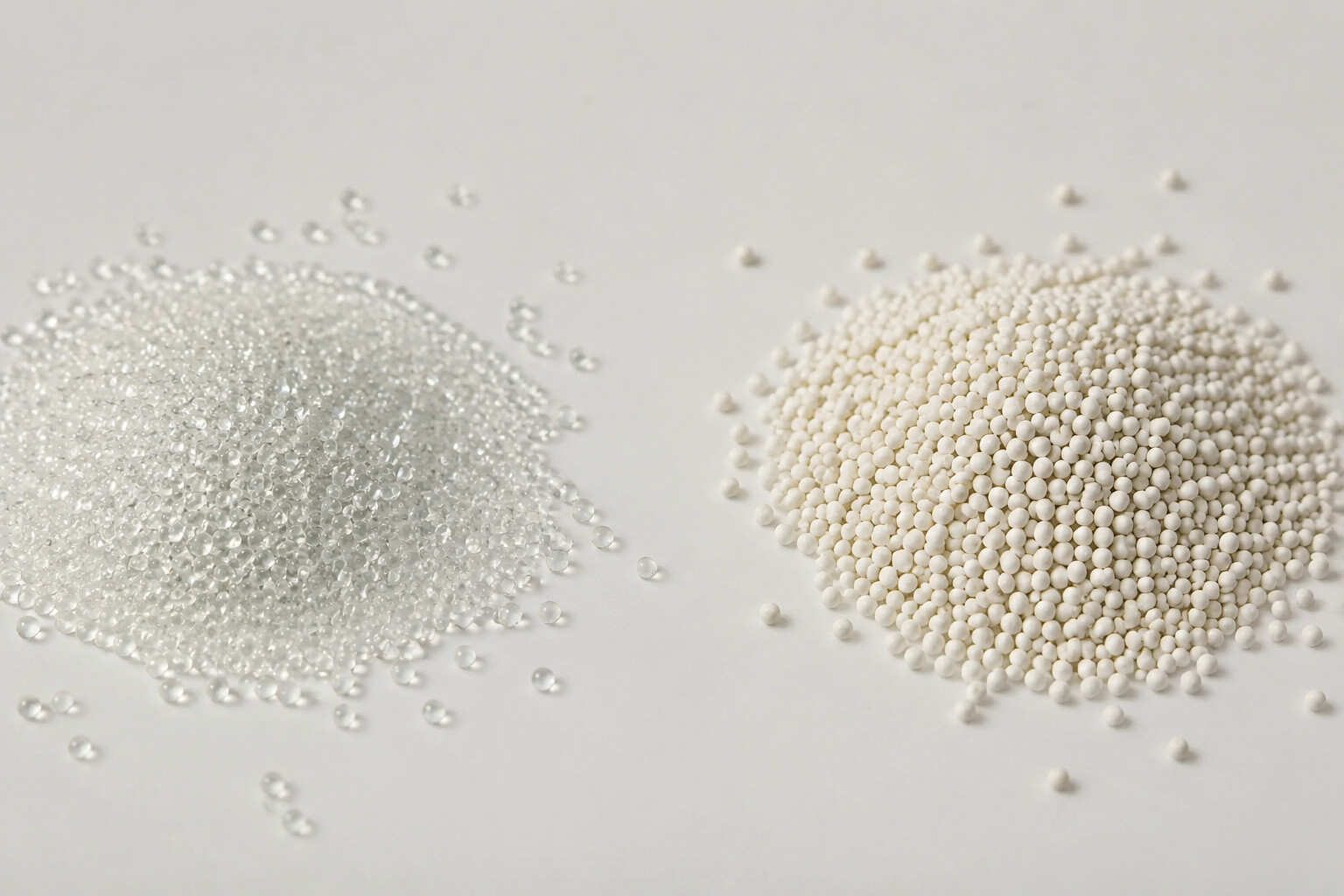
Glass beads are spherical blasting media made from tempered glass. They are used to produce satin and uniform finishes, to treat aluminium and stainless-steel components and for applications where less material removal is required than with an angular abrasive.
The main benefits are:
- uniform and aesthetically pleasing finish;
- less aggressive action than corundum;
- no inherent ferrous contamination from the blasting medium;
- suitable for appropriately configured blasting cabinets and shot-blasting systems;
- potential for recovery as long as particle shape and size remain effective.
Glass beads do not automatically eliminate all risks: dust may come both from progressive breakdown of the blasting medium and from residues removed from the component. Extraction, separation and PPE therefore remain an integral part of the process.
For finishing applications, FEVI offers Microlux glass beads.
Ceramic beads
Ceramic beads are spherical blasting media with high impact resistance. Compared with glass beads, they can offer longer service life, lower fragmentation and good stability of the result over time. They are used on aluminium, stainless steel, moulds and components where a uniform finish, reduced contamination and process control are required.
The initial price is generally higher than that of more common blasting media, but it must be evaluated together with service life, number of recycling cycles and reduced generation of fines. In a correctly adjusted cabinet with efficient recovery and separation, the cost per cycle may be more attractive than the price per kilogram alone suggests.
FEVI offers Cerablast ceramic beads, suitable for compatible compressed-air systems, dry or wet blasting and turbine blasting systems.
Steel shot
The term “steel beads” is sometimes used to describe small-size steel shot. This is a high-density metallic blasting medium capable of transferring a large amount of impact energy. It is intended mainly for closed systems, shot-blasting machines and equipment designed to recover heavy metallic media.
The spherical shape is suitable for:
- shot blasting and peening of metal components;
- removal of mill scale and residues compatible with an impact action;
- surface uniforming and compaction;
- repetitive industrial cycles with abrasive recovery.
It should not be selected solely on the basis of hardness. High density, particle size and flow requirements must be checked against the machine. Its use on stainless steel or materials sensitive to ferrous contamination must also be carefully evaluated: non-ferrous abrasives or dedicated stainless-steel media may be more suitable in these cases.
Iron grit or steel grit: what is the correct term?
The search term “iron grit” is widely used, but does not always identify a single product. In workshop terminology it may be used as a generic expression for metallic blasting media, whereas technically it is necessary to distinguish at least between steel grit, chilled iron grit and stainless-steel media.
Before purchasing, the following should therefore be specified:
- material composition;
- spherical, angular or cylindrical shape;
- particle size;
- hardness;
- carbon content, where relevant;
- compressed-air or turbine blasting system;
- component material and acceptable contamination.
Using a generic name without this information can result in the selection of a blasting medium that is incompatible with either the required result or the equipment.
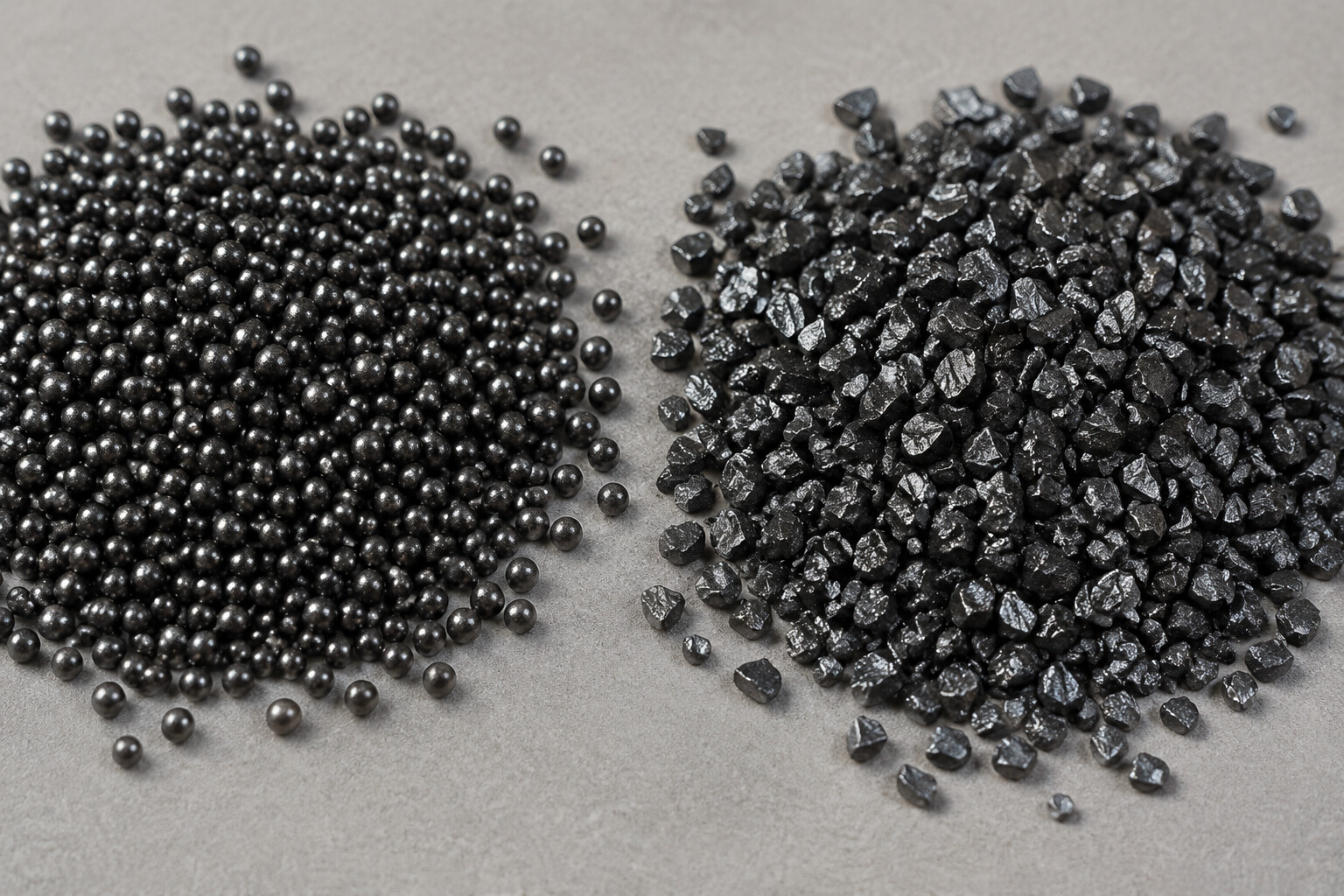
Steel shot: Steel shot is produced by melting and undergoes treatments that control resilience and fatigue resistance. Its rounded shape produces an impact action and generally creates a more uniform finish than angular steel grit. It is particularly suitable for wheel-blast machines, shot-blasting systems and closed-loop recovery processes.
Angular steel grit: Angular steel grit has sharp edges and a stronger cutting action. It is selected when mill scale, oxides or coatings must be removed and an anchor profile created before painting or applying a protective coating. Thanks to its service life and potential for recycling, it can offer competitive operating costs in fixed installations. However, it requires components, separators and recovery systems designed for a high-density metallic abrasive.
FEVI groups spherical and angular metallic media in the Steelblast range.
Comparison table: which abrasive should you choose?
| Abrasive and shape | Action and profile | Applications and considerations |
|---|---|---|
| Brown fused alumina Shape: Angular |
Action: Strong cutting and removal Profile: Medium to pronounced |
Applications: Iron, steel, oxides, rust, coatings Considerations: Component wear and correct particle size |
| White fused alumina Shape: Angular |
Action: Controlled cutting without ferrous contamination Profile: Adjustable |
Applications: Stainless steel, non-ferrous alloys, glass, specialist applications Considerations: Avoid contamination already present in the circuit |
| Glass beads Shape: Spherical |
Action: Finishing and satin finishing Profile: Low |
Applications: Aluminium, stainless steel, aesthetic components Considerations: Progressive breakdown and loss of sphericity |
| Ceramic beads Shape: Spherical |
Action: Uniform finishing with high durability Profile: Low and uniform |
Applications: Stainless steel, aluminium, moulds, precision components Considerations: Initial price and correct recovery management |
| Steel shot Shape: Spherical |
Action: Impact and shot peening Profile: Controlled |
Applications: Castings, forgings, metal components, turbine blasting cycles Considerations: Density, ferrous contamination and machine compatibility |
| Angular steel grit Shape: Angular |
Action: Cutting, removal and anchoring Profile: Pronounced |
Applications: Steel, mill scale, preparation for coatings Considerations: Wear and need for a closed recovery system |
The table provides initial guidance but does not replace an application test. Two abrasives with the same generic name can produce different results when particle size, hardness, actual particle shape, pressure or working distance change.
Application examples: from the surface to the required result
Removing rust and paint from steel
When the objective is to remove resistant layers and create a suitable base for subsequent painting, an angular abrasive is required. Brown fused alumina is versatile in compressed-air systems; angular steel grit becomes particularly interesting in blasting rooms or closed systems equipped with recovery.
Satin finishing stainless steel or aluminium
To obtain a uniform appearance without aggressive cutting, glass or ceramic beads can be considered. Ceramic media provide greater durability and stability; glass beads are a widely used solution suitable for many finishing applications. The circuit must be free from ferrous residues when contamination is not acceptable.
Preparing stainless steel with an anchor profile
When satin finishing is not sufficient and a surface profile must be created, white fused alumina may be more appropriate than beads. Selection must take into account the subsequent coating, the required profile and complete separation from ferrous abrasives previously used in the system.
Processing castings and components in turbine systems
Steel shot and angular steel grit can be selected or mixed according to the required impact level, removal capacity and surface profile. The economic advantage depends on continuous management of the operating mix, separation of fines and controlled replenishment.
Precision operations and delicate components
For small areas and details, a microblaster with a compatible fine abrasive, metering system and nozzle may be required. With the same machine, aluminium oxide produces more pronounced roughening, while glass beads provide a softer and more uniform satin finish.
Compatibility between abrasive and blasting machine
Not every abrasive can be loaded into every blasting machine. Before use, it is necessary to check:
- whether the system is suction, pressure or turbine blasting;
- abrasive density and the circuit's conveying capacity;
- particle size compatibility with the nozzle, metering system and valves;
- availability of recovery, screening and dust separation;
- internal machine materials and resistance to wear;
- any required separation between ferrous and non-ferrous abrasives;
- compressed-air flow and quality.
In a small suction cabinet, for example, a heavy metallic abrasive may not be conveyed correctly. In a blasting room, on the other hand, the recovery and separation system must be designed around the abrasive and the production cycle.
Moisture is another critical factor. Condensation and inadequately treated compressed air can cause agglomeration, irregular metering, blockages and reduced visibility. Before changing abrasive, it is therefore advisable to check the air quality and the condition of the entire circuit.
How to choose in six questions
To narrow down the choice quickly, it is useful to answer the following questions:
- What material is the component made from?
- What must be removed: oxide, rust, paint, mill scale or light residues?
- Is an anchor profile required, or is a satin finish the objective?
- Is ferrous contamination acceptable?
- Can the blasting machine convey and recover that abrasive?
- What is the cost of the complete cycle, including consumption, recycling, wear, dust and processing time?
If one of these answers is missing, selecting an abrasive on price alone can increase consumption, processing time and defects instead of reducing the cost of the operation.
The most common mistakes when choosing blasting media
- Calling every blasting medium “sand” and ignoring composition and shape.
- Using spherical beads when a pronounced anchor profile is required.
- Selecting an angular abrasive that is too aggressive for an aesthetic finish.
- Using metallic grit in a machine that is not designed for its density and wear characteristics.
- Changing from ferrous to non-ferrous abrasive without thoroughly cleaning the circuit.
- Comparing package prices expressed in different units.
- Ignoring air moisture, fine-particle separation and nozzle condition.
- Reusing contaminated abrasive without checking particle shape and size.
FEVI: selecting the abrasive, particle size and blasting system
Abrasive selection should not be separated from blasting-machine selection. FEVI evaluates the process as a whole: material, residue to be removed, required finish, productivity, available air, recovery, extraction and component compatibility.
You can view the complete range of FEVI blasting abrasives, compare corundum and glass beads or learn more about choosing the correct abrasive for a blasting machine.
To identify the correct material and particle size, include the following information in your request:
- type and dimensions of the component;
- surface material;
- residue or coating to be removed;
- required final finish;
- blasting machine model and nozzle diameter;
- expected workload.
Frequently asked questions about corundum, beads and grit
What is the difference between brown fused alumina and white fused alumina?
Both are angular aluminium-oxide-based abrasives. Brown fused alumina is selected for toughness and removal capacity; white fused alumina for its high purity and for applications where the introduction of ferrous particles must be avoided.
How much does corundum for sandblasting cost?
The price depends on type, particle size, purity, packaging, quantity and transport. As of 28 August 2026, FEVI Store lists Coriblast grade 40 at a promotional price of EUR 76.00 + VAT for 25 kg. The current price should always be checked on the product page.
Can corundum be reused?
Yes, in a closed system equipped with recovery, screening and dust separation. The number of reuse cycles is not fixed: it depends on abrasive quality, pressure, material being treated, contamination and the system's ability to remove fines and residues.
For stainless steel, is white fused alumina or glass bead better?
It depends on the required result. White fused alumina is angular and creates roughness; glass beads are spherical and produce a more satin, less aggressive finish. In both cases, ferrous contamination from the machine or previously used abrasives must be avoided.
What is the difference between glass beads and ceramic beads?
Both work mainly through a spherical impact action. Ceramic beads generally provide greater impact resistance, durability and stability, although their initial price is higher. Glass beads are a widely used solution for satin finishing and uniform finishes.
Are steel beads and steel shot the same thing?
The terms are often used as synonyms, particularly for fine particle sizes. For a correct order, however, composition, size, hardness and reference standard should always be specified because commercial terminology can vary.
What is the difference between steel shot and angular steel grit?
Steel shot works mainly by impact and tends to create a more uniform surface. Angular steel grit provides a cutting action, removes material more aggressively and creates a more pronounced anchor profile.
Are iron grit and steel grit the same thing?
Not necessarily. “Iron grit” is often used as a generic term, while the actual product may be carbon steel, chilled iron or another alloy. Composition, shape, hardness and compatibility with the system must be verified.
Which abrasive produces less dust?
Dust generation depends on friability, pressure, number of recycling cycles, separation efficiency and the material being removed. Properly managed ceramic beads and metallic media tend to maintain their shape for longer, but no abrasive eliminates the dust generated by contaminants or residues on the component.
Which abrasive should be used to remove rust and prepare a surface for painting?
An angular abrasive capable of both removing material and creating a surface profile is generally required, such as brown fused alumina or angular steel grit. The correct choice depends on the machine, recovery capability, required profile and contamination risk.
Is a coarser particle size always more effective?
No. A coarser grade can increase impact and roughness, but it can also produce excessive marks, require a different nozzle and reduce precision. The correct particle size is the one that achieves the required result with controlled consumption, processing time and wear.
Can steel grit be used in a portable blasting machine?
Only if the manufacturer confirms compatibility with the density, particle size and feed system. Many portable or suction blasting machines are not designed to convey and recover heavy metallic blasting media correctly.
Ask FEVI to select the correct abrasive
Selecting the ideal abrasive requires a combined assessment of the material, target roughness and available blasting system. Contact the FEVI technical department for personalised advice and an application test on your samples.