

Type of operation
Explanation: Metal surfaces can present layers of rust, old paints, oxidation and contamination that compromise their appearance and make the application of new protective coatings more difficult.
Manual removal using brushes, scrapers or abrasive tools can require considerable time and may be ineffective in corners, cavities, welds and areas with irregular geometries. In addition, uneven treatment can leave adherent residues that reduce the quality of subsequent painting operations.
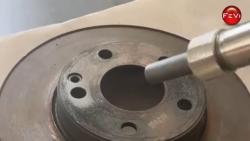
The component shown in the video is used as a demonstration sample to show the removal capacity of the blasting machine on a metal surface affected by rust, paint and oxidation.
Why it happens: Rust forms when ferrous metal is exposed to oxygen and moisture without adequate surface protection. Paints and coatings can also lose adhesion, crack or lift over time, allowing external agents to reach the underlying substrate.
Before applying a new paint, anti-corrosion primer or other protective treatment, it is therefore necessary to remove deteriorated layers and correctly treat the surface.
The FEVI solution
Pressure blasting makes it possible to remove rust, old paints and oxidation quickly and evenly, including from shaped, irregular surfaces or areas that are difficult to reach using traditional manual tools.
For this demonstration, the SABIX 8 Base was used, configured with a 3 mm diameter, 60 mm long Venturi nozzle, an operating pressure of 5 bar and Dustlux 120 angular tempered-glass abrasive.
The angular shape of the abrasive provides effective removal action on surface layers, while the reduced nozzle diameter concentrates the jet and allows the process to be controlled precisely.
| Component | FEVI recommended choice | Technical specifications |
|---|---|---|
| Recommended machine | SABIX 8 Base | Pressure open-blasting machine. Venturi nozzle Ø 3 mm, length 60 mm. Operating pressure 5 bar. |
| Recommended abrasive | Dustlux 120 | Angular tempered-glass abrasive for the controlled removal of rust, paints and oxidation from metal surfaces. |
Mistakes to avoid
- Working without checking the thickness and condition of the metal: Before starting, it is important to assess the condition of the component, especially in the presence of thin sheet metal, deformable parts or surfaces already weakened by corrosion.
- Using excessive pressure: Indiscriminately increasing pressure does not necessarily guarantee a better result. A jet that is too aggressive can unnecessarily etch the substrate or deform thinner metal parts.
- Keeping the jet still on the same point: The gun must be kept moving, maintaining a distance and angle that are as constant as possible, to obtain uniform cleaning and avoid excessively treated areas.
Final result
The metal is cleaner and more uniform, with a surface suitably treated for subsequent phases such as the application of primers, anti-corrosion undercoats, paints or other protective coatings.
The process also makes it possible to work accurately on corners, cavities, welds and complex geometries, reducing the need for prolonged manual operations.
Frequently asked questions
Can blasting be used on any metal surface?
Blasting can be used on many metal artefacts and components, but the configuration must be selected according to the type of metal, thickness, surface condition and required result. More controlled parameters must be used on thin sheet metal or delicate components.
Can the surface be painted immediately after blasting?
After blasting, residual dust should be removed accurately and the planned protective cycle should be applied promptly. Newly treated metal can begin to oxidise again if it remains exposed to moisture.
Choose the ideal solution for your restoration operation
Removing rust, old paints and oxidation requires a balanced configuration of air pressure, nozzle diameter, compressor airflow and type of abrasive.
The solution must be defined according to the material being treated, component thickness, consistency of the layer to be removed, surface dimensions and required final finish.
If you need to carry out a cleaning or treatment operation on a metal surface, tell us:
• the type of component or artefact;
• its dimensions;
• the thickness and type of metal;
• the material to be removed;
• the compressor at your disposal;
• the final result you want to achieve.
The FEVI technical office will help you configure the most suitable solution by identifying the blasting machine, nozzle, operating pressure and abrasive required for effective, controlled and professional work.
Request advice or a quote