
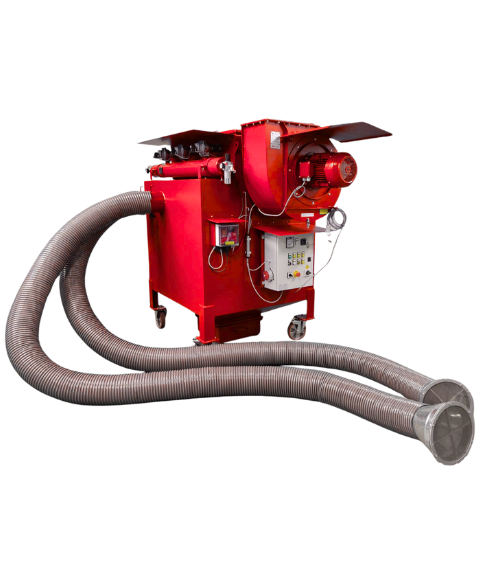


Portable FEVI dust collectors for blasting dust
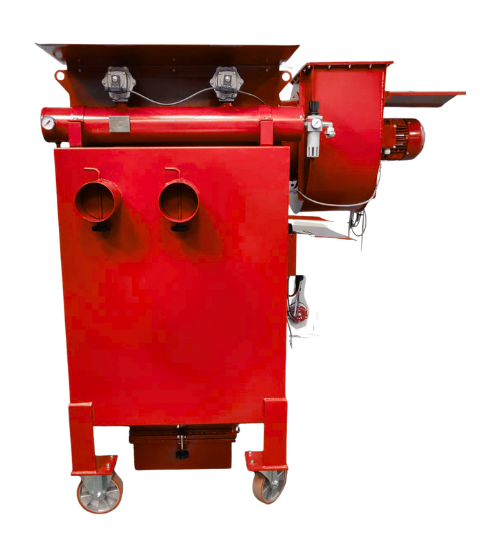
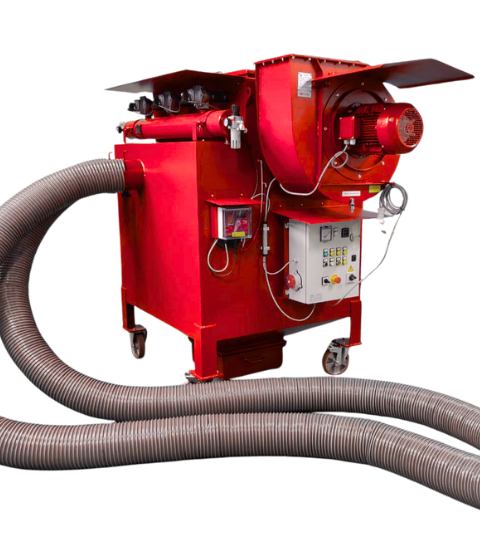
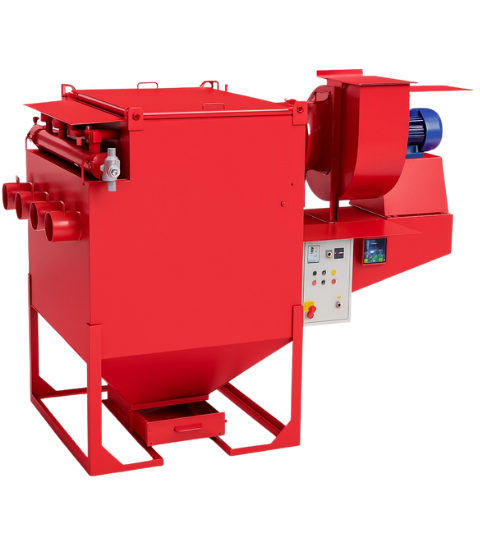
FEVI portable dust collectors are dry filtration systems designed for the extraction and filtration of particles produced during abrasive blasting operations.
They are particularly suitable when blasting is carried out in enclosed, confined or difficult-to-access areas, where dust can remain airborne, reduce visibility and settle on equipment and surrounding surfaces.
Unlike a fixed system, a portable dust collector can be moved and positioned close to the work area. This makes it suitable for industrial sites, maintenance work, off-site operations and applications where the working configuration changes frequently.
Who it is recommended for
The FEVI portable dust collector is suitable for:
- companies carrying out blasting in confined spaces;
- industrial maintenance companies;
- industrial and shipyard sites;
- companies working inside tanks and vessels;
- operators carrying out work inside ducts and pipework;
- companies blasting inside containers, pits or technical rooms;
- companies using open blasting machines in enclosed spaces;
- industrial departments that need to improve dust management;
- operators requiring a mobile, repositionable system;
- companies seeking to reduce residue accumulation after treatment.
Main applications
Internal blasting of tanks and vessels
During blasting of the internal surfaces of a tank or vessel, dust can accumulate rapidly and impair visibility.
The portable dust collector can be positioned close to the access point and connected to the working area to extract particle-laden air and convey it to the filtration system.
Blasting inside pipes and ducts
Industrial pipes and ducts often feature restricted spaces, varying geometries and limited access points.
A portable system makes it possible to adapt the extraction arrangement to the characteristics of the job and the position of the area to be treated.
Containers, pits and technical rooms
In enclosed areas, dust can remain airborne and spread quickly.
Dedicated extraction helps improve visibility and limit the deposition of particles on equipment and in adjacent areas.
Industrial sites and shipyards
On worksites, the location of the operation can change frequently.
The mobile structure of the dust collector allows the system to be moved between different working areas and positioned according to the requirements of the job.
Open blasting in enclosed spaces
When an open blasting machine is used in an enclosed or partially confined area, airborne dust must be managed appropriately.
The portable dust collector can be used together with the blasting machine to extract and filter the air within the working environment.
Maintenance and temporary operations
The mobile configuration is suitable for temporary work, planned maintenance, off-site operations and applications where installing a fixed dust-extraction system would not be justified.
How the dust collector works
During blasting, the abrasive stream acts on the surface to remove paint, oxidation, mill scale, residues, encrustations or other materials.
This action generates dust consisting of removed material, fragmented abrasive and particles detached from the surface.
The dust collector operates in four stages.
1. Extraction of dust-laden air
Air is drawn from the blasting area through a connection sized according to the working environment, distance and quantity of dust generated.
2. Cartridge filtration
The air reaches the filtration system. Polyester cartridges retain the solid particles generated during the process.
3. Automatic compressed-air cleaning
Dust deposited on the surface of the cartridges is removed by automatic pulses of compressed air.
The self-cleaning system helps maintain filtration efficiency and reduce interruptions during operation.
4. Management of filtered air
After passing through the cartridges, the treated air is managed according to the system configuration, characteristics of the working environment and requirements applicable to the specific application.
Why choose a portable FEVI dust collector
Mobile and repositionable system
The dust collector can be positioned close to the work area and moved between different operating zones.
This is particularly useful on worksites, during industrial maintenance and for off-site operations.
Suitable for confined spaces
The system is designed for applications in tanks, vessels, ducts, containers and industrial areas where management of dust-laden air is particularly important.
Cartridge filtration
The polyester cartridges retain particles produced during blasting and allow the extracted air from the working environment to be treated.
Automatic self-cleaning
Compressed-air pulses remove dust deposited on the cartridges and help maintain the efficiency of the filtration system.
Compact structure
Compact overall dimensions facilitate transport, handling and positioning, including on worksites or in areas with restricted access.
Controlled residual emissions
For the configuration described, residual emissions below 3 mg/Nm³ are indicated.
The actual value must be verified according to the selected configuration, dust characteristics and operating conditions.
Customisable configurations
The system can be defined according to the volume of the working environment, amount of dust generated, duration of the operation and handling requirements.
Industry 4.0 ready
Configurations are available with provision for remote monitoring, digital operation management and automated cartridge-cleaning cycles.
Operating advantages
Using a dust collector during blasting can:
- improve visibility in the working area;
- reduce the amount of airborne dust;
- limit dispersion towards surrounding areas;
- reduce residue accumulation at the end of the operation;
- support work in enclosed or confined spaces;
- allow the system to be moved between several working areas;
- adapt extraction to the characteristics of the worksite;
- make management of the blasting cycle more organised;
- provide greater protection for equipment located in the area;
- integrate filtration into a configuration designed for the application.
The dust collector does not eliminate the need for proper risk assessment or for the use of the protective equipment required for the operation.
Technical features
| Feature | Description |
|---|---|
| Type | Portable dry dust collector |
| Application | Extraction and filtration of dust generated during blasting |
| Filtration system | Polyester cartridges |
| Filter cleaning | Automatic self-cleaning using compressed-air pulses |
| Configuration | Mobile and positionable close to the working area |
| Operating environments | Tanks, vessels, pipes, containers, worksites and industrial areas |
| Indicated residual emissions | Below 3 mg/Nm³, depending on the specified configuration |
| Digital management | Provision for monitoring and Industry 4.0 integration |
| Sizing | Defined according to the environment, dust, abrasive and operating cycle |
| Customisation | Configuration assessed according to the application |
Compatibility with FEVI blasting machines and systems
The portable dust collector can be considered for use together with:
- open blasting machines;
- pressure blasting machines;
- systems for internal pipe blasting;
- blast rooms;
- operations inside tanks and vessels;
- work in confined spaces;
- industrial and shipyard sites;
- temporary configurations where a fixed system cannot be installed.
Sizing must take into account the volume of air to be treated and the actual operating conditions.
Portable dust collector or fixed system?
| Fixed system | Portable dust collector |
|---|---|
| Suitable for permanent production areas | Suitable for worksites and variable operations |
| Permanent installation | Position can be changed according to the job |
| Suitable for continuous operating cycles | Suitable for maintenance and temporary operations |
| Integrated into dedicated rooms or production lines | Can be connected to the blasting area as required |
| Requires permanent space and connections | Facilitates transport and off-site use |
| Sized for a defined workstation | Can be used in different working areas |
A portable dust collector is suitable when blasting is carried out in different locations, in areas with limited access or where a permanent system would not be technically or economically justified.
When to choose a portable system
A portable dust collector is suitable when:
- you need to blast in an enclosed or confined space;
- you work inside tanks, vessels or ducts;
- you cannot install a fixed dust-extraction system;
- you need to move the system between several working areas;
- you want to improve visibility during blasting;
- you need to reduce dust accumulation in the working environment;
- you use an open or pressure blasting machine;
- you carry out industrial maintenance or temporary operations;
- you require a compact system that is easy to move;
- you want to integrate the system into an advanced digital management setup.
Dust collector, industrial vacuum cleaner or recovery blasting machine?
These systems perform different functions.
-
Dust collector
Extracts and filters dust-laden air from the environment where blasting is being carried out.
It is suitable for rooms, tanks, vessels, pipes and areas where dust disperses during treatment.
-
Industrial vacuum cleaner
Collects deposited materials, concentrated dust, residues and abrasive from the floor or from a specific point in the system.
Its primary function is material collection, not air exchange for the entire working environment.
-
Recovery blasting machine
Extracts abrasive and dust directly from the surface during treatment.
It is suitable for localised operations where the recovery head can remain in contact with the surface.
When to consider another FEVI solution
-
Blast rooms
For large components and operations carried out in a permanent environment with integrated extraction, lighting and abrasive management.
-
Blasting cabinets
For small or medium-sized components treated through glove ports and viewing windows, keeping the operator separated from abrasive and dust.
-
Recovery blasting machines
For localised operations where abrasive and dust need to be extracted immediately and directly from the treated surface.
-
Water-assisted blasting
When the objective is to reduce airborne dust by pre-dampening the abrasive.
-
FEVI-gloo
When a closed, dust-controlled working environment needs to be created quickly for blasting, shot blasting, grinding or sanding operations.
-
Industrial vacuum cleaners
For collecting abrasive, deposited materials, dust and residues during or after industrial operations.
How to size the dust collector
Selection should not be based only on the external dimensions or power of the system.
To define the correct configuration, the following must be assessed:
- volume of the working environment;
- surface and material to be treated;
- type of residue to be removed;
- abrasive used;
- nature and quantity of dust generated;
- duration and continuity of the operation;
- length and cross-section of the extraction connections;
- distance between the dust collector and the working area;
- possibility of discharging the air outdoors;
- available access for transport and positioning;
- frequency of operations;
- method used to manage collected dust;
- any requirements imposed by the worksite or facility.
Where combustible, hazardous or potentially explosive dust is present, the applicable requirements and suitability of the configuration must be assessed separately.
Safety and assessment of the working environment
Dust control must be considered an integral part of planning the blasting operation.
Before selecting the system, the following should be verified:
- characteristics of the working environment;
- access points and escape routes;
- air exchange;
- type of dust;
- abrasive used;
- material removed from the surface;
- duration of the operation;
- personal protective equipment;
- methods of communication with the operator;
- procedures required for confined spaces;
- any emission limits or requirements.
The dust collector helps control dust, but does not replace risk assessment, operating procedures or the required protective equipment.
FAQ about dust collectors for blasting
What is a dust collector for blasting?
Discover the answer
It is a system that extracts dust-laden air generated during blasting and retains the particles through filtration elements.
What is it used for during blasting?
Discover the answer
It is used to reduce the amount of airborne dust, improve visibility and limit the dispersion of particles into surrounding areas.
What is the difference between a dust collector and an industrial vacuum cleaner?
Discover the answer
A dust collector mainly treats dust-laden air within the working environment. An industrial vacuum cleaner is normally used to collect deposited material, residues, abrasive or concentrated dust from a specific point.
Does the dust collector also recover the abrasive?
Discover the answer
Its primary function is to extract and filter airborne dust. Where abrasive needs to be recovered directly from the surface, a recovery blasting machine is more suitable.
When is a portable dust collector the right choice?
Discover the answer
When operating on worksites, inside tanks, vessels, pipes or in environments where a fixed system cannot be installed.
Can it be used in a confined space?
Discover the answer
The system is also intended for applications in confined spaces. Its use must form part of an overall assessment that considers ventilation, access, dust characteristics, protective equipment and operating procedures.
What type of filtration does it use?
Discover the answer
The system uses polyester cartridges with automatic cleaning by compressed-air pulses.
What residual emission level is indicated?
Discover the answer
For the configuration described, residual emissions below 3 mg/Nm³ are indicated. The value must be verified according to the model and actual operating conditions.
How is the dust collector capacity selected?
Discover the answer
Sizing depends on the volume of the working environment, the quantity and type of dust, the abrasive, duration of the operation and configuration of the extraction connections.
Can FEVI design the system configuration?
Discover the answer
Yes. FEVI analyses the working environment, application, dust generated and operating methods to identify the most suitable configuration.