
 , Sandblasting machines with cabin


The project requirement
Explanation: When a component can be lifted easily and positioned on the internal support, a standard blasting cabinet is often the simplest solution.
The situation changes when the component becomes heavy, bulky, difficult to handle or needs to be rotated several times in order to reach all surfaces correctly.
In these cases, the challenge does not concern surface treatment alone.
It is necessary to determine:
- Where the component should be positioned before treatment;
- How it can be loaded without unnecessary handling;
- How it can be transferred into the chamber;
- How it can be oriented during blasting;
- How it can be removed once the cycle has been completed.
The technical response: bringing the support on which the component is positioned outside the cabinet makes it possible to turn loading into a separate and more accessible stage of the process.
Application analysis
The design of a cabinet with trolley must start first and foremost from the component.
Weight, dimensions, geometry, centre of gravity and the position of the surfaces to be reached determine both the machine structure and the handling system.
The trolley must provide stable support during transfer, while the table must allow the component to be oriented according to the different areas to be treated.
It is also important to consider the space available in front of the cabinet.
The possibility of moving the loading platform outside the machine makes it possible to prepare the component in an accessible area, avoiding the need to carry out all positioning operations inside the chamber.
Where weight and dimensions require it, the design can also be coordinated with the handling equipment already available within the facility.
The objective always remains the same: to reduce the difficulty of handling the component before blasting even begins.
The solution designed by FEVI
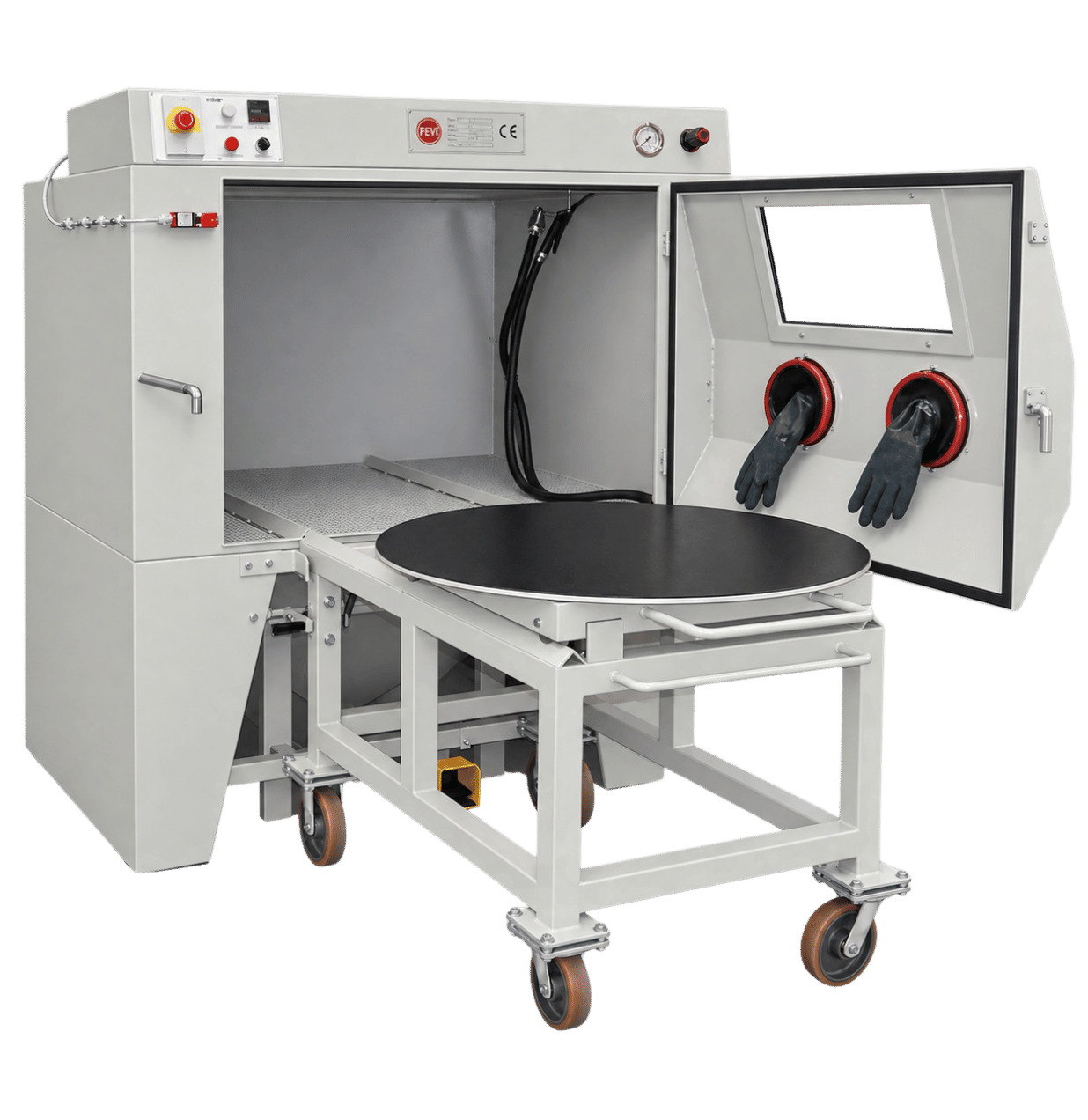
The configuration developed by FEVI integrates three main elements: a large front opening, a mobile trolley and a rotary table.
The cabinet has a large opening that allows the trolley to be brought up to the internal working area.
A circular table for positioning the component is installed on the trolley. The frame is fitted with wheels, allowing the complete assembly to be moved independently of the main cabinet structure.
This solution allows the component to be prepared while the table is outside the cabinet.
The front door incorporates the operator station with:
- Large viewing window;
- Two glove ports;
- Dedicated closing structure.
The main controls, a pressure gauge, the pneumatic circuit and the working hose used inside the chamber are also visible on the machine.
The combination of these different elements means that the trolley is not simply an external accessory, but a functional part of component handling.
How the system works
The first stage takes place with the trolley outside the cabinet.
The component can be positioned directly on the rotary table, where it can be centred and prepared for treatment.
The trolley is then brought up to the large front opening and the component moved into the required position within the treatment area.
Once the cabinet has been closed, the operator monitors the process through the viewing window and works through the glove ports.
During treatment, the table allows the orientation of the component to be changed so that different surfaces can be progressively reached.
Once treatment has been completed, the trolley can be moved back outside, making the component accessible again for subsequent operations.
The operating principle is:
Load outside → Transfer → Blast → Rotate → Complete treatment → Remove.
Why use an external trolley?
The main advantage of the trolley is that it separates the loading stage from the cabinet's operating area.
A heavy or bulky component can be more difficult to position correctly when the available space is limited by the machine walls.
By bringing the component support outside the cabinet, a more accessible loading area is created.
This makes it possible to plan component positioning more freely and, where necessary, coordinate loading with other handling equipment.
The trolley therefore becomes the link between component logistics and the blasting process.
Why integrate a rotary table?
Once the component has been introduced into the cabinet, the next challenge is to reach all the surfaces involved in the treatment.
With a fixed support, a substantial component may require continuous repositioning.
The rotary table instead allows the orientation of the component to be changed while keeping it on the same support.
The operator can progressively bring different sides, surfaces and geometries towards the working area.
This solution can be particularly useful for circular components, castings, machine bodies, welded structures and three-dimensional parts requiring treatment on several sides.
The trolley facilitates transfer; the table facilitates orientation.
It is the integration of these two functions that defines this configuration.
- Component loading outside the cabinet;
- Greater accessibility during positioning;
- Component transfer using a dedicated trolley;
- Possibility of keeping the component on the same support throughout the different stages;
- Component rotation inside the working area;
- Progressive access to different surfaces;
- Reduced need to reposition the component manually;
- Possibility of designing the table and trolley around the component;
- More rational organisation of loading, treatment and unloading stages;
- Possibility of further developing the system according to production requirements.
System features
| Element | Configuration |
|---|---|
| Type | Custom industrial blasting cabinet |
| Main access | Large front opening |
| Door | Front hinged door |
| Component handling | Dedicated mobile trolley |
| Component support | Circular table |
| Component orientation | Rotary table |
| Loading | Can be carried out with the table outside the cabinet |
| Operator station | Integrated into the front door |
| Visual inspection | Large viewing window |
| Manual access | Two glove ports |
| Machine controls | Installed on the upper structure |
| Foot control | Included |
| Pneumatic circuit | Included |
| Working hose | Installed inside the chamber |
| Trolley load capacity | Data not available |
| Table load capacity | Data not available |
| Table drive | Data not available |
| Abrasive | To be defined according to the application |
| Useful dimensions | To be defined according to the component |
Possible applications
This configuration can be considered when the component's weight, dimensions or geometry make loading outside the cabinet advantageous.
Possible applications include:
- Castings;
- Pump bodies;
- Valve bodies;
- Flanges;
- Wheels and circular components;
- Moulds;
- Gearboxes;
- Casings;
- Mechanical components;
- Welded assemblies;
- Fabricated metal components;
- Three-dimensional components;
- Heavy parts that are difficult to handle manually;
- Components requiring treatment on several sides.
However, the component category does not automatically determine the solution.
The correct configuration always depends on the combination of weight, dimensions, geometry, material, abrasive, required surface result and productivity.
Loading, handling and treating: one project
When designing a special-purpose machine, blasting cannot be considered separately from component handling.
A technically effective system that is difficult to load can make the entire production cycle inefficient.
For this reason, FEVI can analyse not only the treatment chamber, but also how the component reaches the machine, is positioned and subsequently handled.
Depending on the application, the following can be considered:
- Trolleys;
- Rotary tables;
- Roller conveyors;
- Rails;
- Lifting systems;
- Pneumatic handling systems;
- Automatic doors;
- Dedicated supports;
- Semi-automatic or automatic configurations.
The machine is therefore developed around the actual process, not merely around the dimensions of the component.
A machine designed around the component
The blasting cabinet with trolley and rotary table clearly reflects the FEVI design principle.
The component is considered before the machine.
How must it be loaded? How much does it weigh? From which sides must it be treated? Can it be handled manually? Does it need to be rotated? How much space is available around the machine?
The answers to these questions define the configuration.
In this case, the trolley and rotary table become integral parts of the solution because they allow the component to be managed before, during and after treatment.
This is the transition from a simple blasting cabinet to a system developed around the application.
Custom system or standard blasting cabinet?
Not every component requires a dedicated trolley or a large table.
For parts that are easy to handle, it may be more appropriate to use a standard blasting cabinet, possibly equipped with a conventional internal table or specific accessories.
FEVI can assess different levels of configuration:
- Manual blasting cabinets;
- Professional blasting cabinets;
- Cabinets with rotary tables;
- Cabinets with removable trolleys;
- Systems with abrasive recovery;
- Shot blasting cabinets;
- Semi-automatic systems;
- Systems with dedicated handling equipment;
- Automatic abrasive blasting and shot blasting systems;
- Fully customised machines.
The objective is not to make every machine special, but to identify the level of customisation genuinely required by the customer's process.
Frequently asked questions – Blasting cabinet with trolley and rotary table
What is a blasting cabinet with trolley used for?
The trolley allows the component to be positioned outside the chamber and then transferred into the blasting area. It is particularly useful when the component is heavy, bulky or difficult to handle directly inside the cabinet.
What is the advantage of a rotary table?
The table allows the orientation of the component to be changed during treatment, progressively making different surfaces accessible without necessarily having to remove and reposition the component.
Can heavy components be loaded onto the table?
A customised machine can be designed according to the weight of the component. However, the trolley structure, table and handling system must be sized according to the actual load capacity required.
Is the component loaded outside the cabinet?
In a configuration with a mobile trolley, one of the main advantages is precisely the possibility of preparing the component while the support is outside the treatment area.
Can the rotary table be motorised?
Rotation can be configured in different ways according to component weight, dimensions, cycle frequency and required level of automation. The choice is made during system design.
Can this configuration be used for shot blasting?
The mechanical configuration can be designed for different treatment processes. Abrasive, projection system, recovery system and machine characteristics must be defined according to the required result.
Can FEVI manufacture a trolley to match the dimensions of the component?
In a customised system, trolley geometry, table dimensions, load capacity and handling system can be defined starting from the characteristics of the component to be treated.
Do you need to blast a heavy component or one that is difficult to handle?
When the challenge is not only reaching the surface, but also loading, moving and rotating the component, the system must be considered as a whole.
FEVI can analyse the component and process to identify the most suitable configuration: from a standard cabinet to a customised abrasive blasting or shot blasting system with dedicated handling equipment.
TELL US ABOUT YOUR PROJECT
For an initial assessment, you can provide:
- Photographs of the component;
- Material;
- Dimensions;
- Weight;
- Quantity to be treated;
- Surfaces involved in the process;
- Currently available handling method;
- Required surface result.
Machine design starts from the component that needs to be treated.