 , Sandblasting machines with cabin


The project requirement
Explanation: A standard blasting cabinet allows the operator to work through a viewing window and two front-mounted glove ports.
This configuration is effective for most conventional applications, but it can become limiting when the component has:
- Considerable depth;
- Three-dimensional geometry;
- Surfaces distributed across several sides;
- Large dimensions;
- Areas that are difficult to reach from the front;
- A weight that makes repositioning impractical;
- A requirement to be loaded using a dedicated support.
Under these conditions, simply increasing the size of the cabinet does not necessarily solve the problem.
A larger component inside a larger chamber may still have surfaces that are difficult to reach from the operator's position.
The technical response: it therefore becomes necessary to design the points from which the component must be accessible for treatment.
Application analysis
The design must start from the actual geometry of the component and the position of the surfaces to be treated.
The following must be assessed:
- Width;
- Height;
- Depth;
- Weight;
- Centre of gravity;
- Loading method;
- Front surfaces;
- Side surfaces;
- Any cavities;
- Internal or recessed areas;
- Need to rotate the component;
- Possibility of moving it during the cycle.
A component may fit perfectly within the chamber dimensions while still being impractical to treat if the operator can reach it from only one direction.
The solution may therefore be not to keep moving the component, but to create a second operating position around it.
The solution designed by FEVI
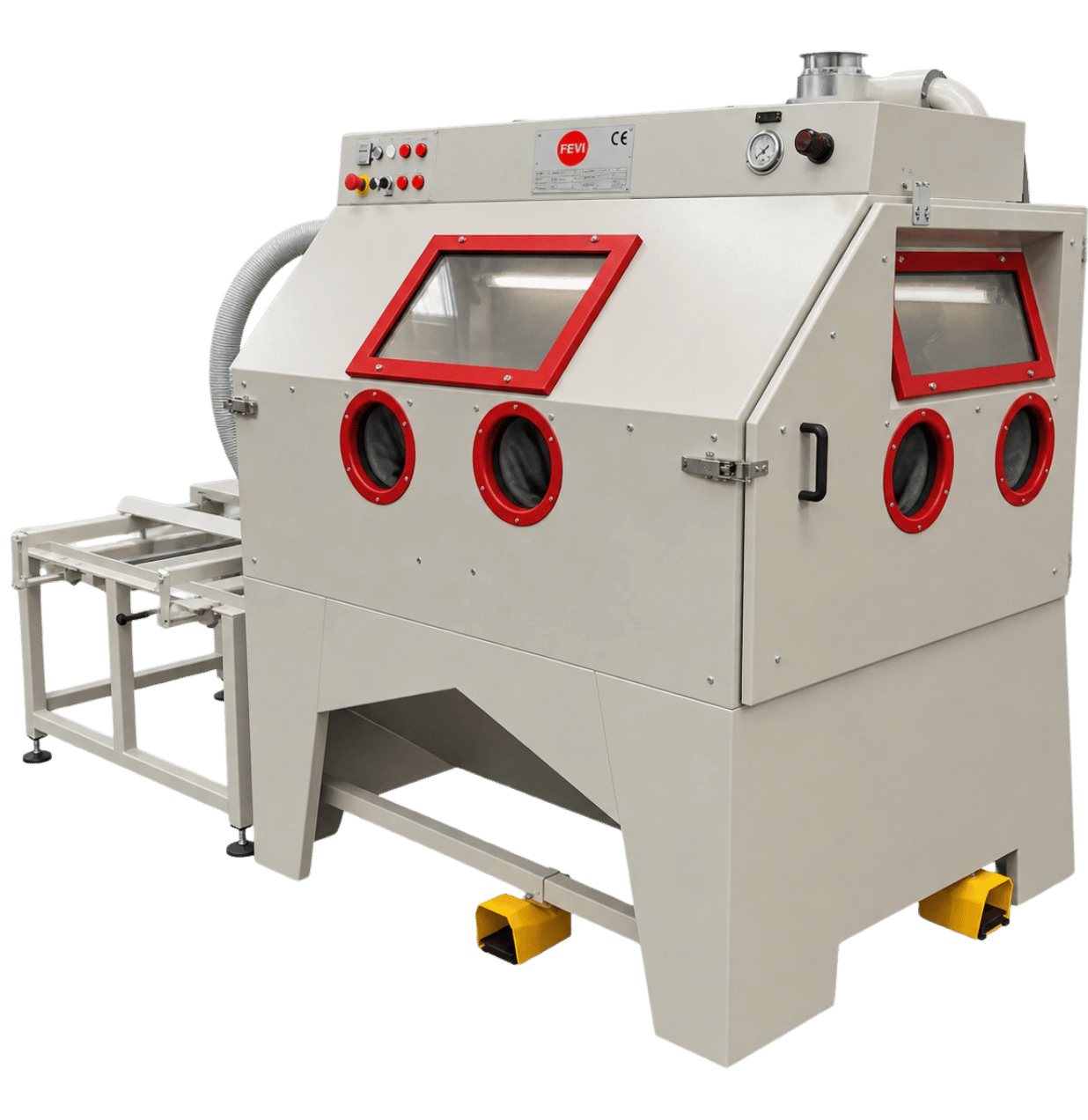
The FEVI cabinet features a large industrial structure with two operating areas oriented on different sides of the treatment chamber.
The main operating station includes:
- Large viewing window;
- Two glove ports;
- Front access to the internal working area.
A second operating station is positioned on the side of the machine and includes:
- Dedicated viewing window;
- Two additional glove ports;
- Access to the same treatment area from a different direction.
The machine therefore has two operating windows and four glove ports in total, arranged on two different sides of the cabinet.
An external structure for component handling is also visible, configured as a loading and transfer trolley.
The machine also includes:
- Machine controls;
- Pressure gauge;
- Pneumatic connections;
- Upper system connected to process management;
- Lower structure dedicated to material collection;
- Foot controls.
The distinctive design feature is therefore the integration of component handling with accessibility from several sides.
How the system works
The component can be positioned on the trolley outside the treatment area.
This makes it possible to organise loading with more available space than inside the cabinet.
The trolley is then moved into the position specified for the process.
Once the machine is ready, the operator can work from the main station using the front viewing window and glove ports.
When the component geometry requires access to a side surface or an area that is difficult to reach from the first position, the additional side station can be used.
The component can therefore be treated from different directions while remaining in the same general position inside the chamber.
Once the process is complete, the trolley allows the component to be returned to the external area for unloading.
The process logic becomes:
Loading → Trolley transfer → Front treatment → Side treatment → Completion → Trolley extraction → Unloading.
Why use an additional side operating station?
The main advantage is the ability to reach a three-dimensional component more effectively.
A front operating station inevitably creates a specific working field.
If a surface is located on the opposite side or has an unfavourable angle, the operator may be forced to:
- Change working position;
- Hold the blasting gun at an unnatural angle;
- Rotate the component;
- Remove the component;
- Reposition it.
An additional side station instead brings the operator closer to the surface rather than continuously moving the surface towards the operator.
This principle is particularly useful with bulky or heavy components, where each repositioning operation may require time and dedicated equipment.
Front and side operating stations: two working angles
The most interesting feature of this machine is not simply the presence of four glove ports. It is their distribution across two sides of the cabinet.
The front station allows one portion of the component to be reached. The side station provides a second operating angle.
In this way, the cabinet design follows the three-dimensional geometry of the component.
This concept can be developed further, depending on the application, through:
- Additional operating stations;
- Different glove-port heights;
- Rotary tables;
- Trolleys;
- Specific supports;
- Handling systems;
- Dedicated openings.
The operator's position therefore becomes a genuine design variable.
The role of the handling trolley
The trolley allows the component to be managed separately from the working chamber.
The component can be prepared while the support is outside the cabinet, where loading operations are generally more accessible.
It can then be transferred into the operating area while remaining on the same support.
This solution can reduce the need for lifting and repositioning operations to be carried out directly inside the cabinet.
The trolley therefore performs a complementary function to the two operating stations:
the trolley brings the component into the correct position; the operating stations allow the operator to reach it from different directions.
- Access to the component from two different sides;
- Greater surface coverage;
- Dedicated front operating station;
- Additional side operating station;
- Four glove ports in total;
- Two viewing windows;
- Possibility of reducing component repositioning;
- Improved management of three-dimensional components;
- Possibility of treating side areas or surfaces that are difficult to reach;
- Loading using a dedicated trolley;
- Component preparation outside the cabinet;
- Integration between handling and treatment;
- Configuration adaptable to component geometry.
System features
| Element | Configuration |
|---|---|
| Type | Custom industrial blasting cabinet |
| Main operating station | Front |
| Additional operating station | Side |
| Viewing windows | Two |
| Glove ports | Four |
| Station orientation | On two different sides |
| Component handling | By dedicated trolley |
| External loading | Possible using the trolley |
| Operating mode | Manual |
| Machine controls | Included |
| Foot controls | Included |
| Pressure gauge | Included |
| Pneumatic connections | Included |
| Upper process system | Included |
| Lower collection area | Integrated into the structure |
| Trolley load capacity | Data not available |
| Useful chamber dimensions | To be defined according to the application |
| Simultaneous use of the stations | To be defined according to the project |
| Abrasive | To be defined according to the application |
| Process | Abrasive blasting or shot blasting depending on the required configuration |
Possible applications
A blasting cabinet with an additional side operating station and trolley can be considered when the component has surfaces distributed in several directions and continuous repositioning would be impractical.
Possible applications include:
- Machine bodies;
- Castings;
- Welded structures;
- Fabricated metalwork;
- Moulds;
- Pump bodies;
- Valve bodies;
- Gearbox housings;
- Casings;
- Complex mechanical components;
- Three-dimensional components;
- Components with cavities or recesses;
- Bulky parts;
- Parts with side surfaces that are difficult to reach;
- Heavy components requiring a handling trolley.
The configuration must be defined by analysing the actual component and the required surface result.
When continuously rotating the component is not the best solution
One way of reaching different surfaces is to rotate the component. However, this is not always straightforward.
A heavy component may require lifting equipment. Irregular geometry can make it difficult to identify a new stable position. A bulky component may require considerable space for handling.
In these cases, changing the position from which the treatment is carried out may be more rational.
The additional side operating station is based precisely on this principle:
do not necessarily move the component when a second access point to the surface can be created.
Ergonomics and accessibility are part of the design
The design of a special-purpose cabinet must consider more than just the internal volume.
It is necessary to understand how the operator will actually interact with the component.
Glove-port height, viewing-window dimensions, chamber depth, component position and working angle directly affect how easily the surfaces can be reached.
For this reason, FEVI can develop configurations in which the operating stations are positioned according to the geometry of the component.
The machine is not simply made larger. It is organised around the component and the operator.
A machine designed around the component
The FEVI blasting cabinet with additional side operating station and trolley clearly represents the principle of customisation applied to the process.
The starting point is not: “How large should the cabinet be?”
The questions instead become:
How is the component loaded? From which sides must it be treated? Which surfaces are the most difficult to reach? Can it be rotated easily? Where should the operator be positioned?
The configuration is developed from this information.
In this case, FEVI integrated a trolley and two different operating points into the machine, demonstrating how the operator's position can itself become a design element of the blasting system.
Custom system or standard blasting cabinet?
Not every component requires multiple operating stations.
When the component can be reached easily from the front, a standard blasting cabinet with a single operating station normally represents the simplest solution.
As dimensions and complexity increase, the following can instead be considered:
- Standard blasting cabinets;
- Cabinets with rotary tables;
- Cabinets with trolleys;
- Cabinets with side operating stations;
- Dual-station cabinets;
- Cabinets with roller conveyors;
- Hook-type systems;
- Shot blasting cabinets;
- Semi-automatic systems;
- Automatic abrasive blasting and shot blasting systems;
- Fully customised machines.
FEVI can therefore define the level of customisation actually required according to the component and production cycle.
Frequently asked questions – Blasting cabinet with side operating station and trolley
What is the purpose of an additional side operating station?
It allows the component to be reached from a second direction. It can be useful when certain side surfaces or internal areas are difficult to treat using only the front operating station.
What is the difference compared with a cabinet with four front glove ports?
With four glove ports positioned at the front, the main benefit is an increase in the width of the accessible area. When one pair is positioned on the side, the angle from which the operator can work on the component also changes.
Which components can benefit from a cabinet with a side operating station?
It can be suitable for bulky parts, three-dimensional components, castings, welded structures, machine bodies and components with surfaces distributed across several sides.
What is the purpose of the trolley?
The trolley allows the component to be prepared and handled separately from the treatment chamber, facilitating loading and subsequent transfer into the operating position.
Can the trolley be designed according to the component weight?
Yes. In a customised machine, the trolley structure, dimensions and load capacity must be defined according to the actual weight and geometry of the component.
Can the two operating stations be used at the same time?
The presence of two operating stations does not automatically imply simultaneous operation by two operators. This possibility must be specifically provided for and verified during the machine design stage.
Can the configuration also be used for shot blasting?
The machine can be configured according to the required process. The abrasive, projection system, recovery system and internal characteristics must be defined according to the material and required surface result.
Is your component difficult to reach from a single position?
When the component has surfaces distributed across several sides, continuously moving the part is not necessarily the best solution.
FEVI can analyse operator position, handling requirements and chamber geometry to identify the most effective configuration: from a conventional cabinet to a system with trolley, additional operating stations and customised handling systems.
TELL US ABOUT YOUR PROJECT
For an initial assessment, you can provide:
- Photographs of the component;
- Material;
- Dimensions;
- Weight;
- Surfaces to be treated;
- Areas that are difficult to reach;
- Quantity to be processed;
- Handling method;
- Required surface result.
We do not simply design the space required to contain the component: we also design how to reach it.