
OLYBLAST is a mineral-based blasting abrasive composed mainly of olivine and developed to provide an effective combination of abrasive performance, versatility and attention to safety. The S2 version offered by FEVI has a particle size ranging from 0.1 to 0.5 mm and is suitable for a variety of surface treatment applications. It can be considered for metal, concrete and wood, as well as for applications in the construction, automotive and marine sectors.
Its most significant advantage is the absence of detectable free crystalline silica according to the technical documentation. This distinguishes OLYBLAST from traditional silica sand and contributes to a more informed choice of abrasive. However, this does not mean that blasting is dust-free or that work can be carried out without protection: the process can generate respirable fractions and always requires suitable containment, extraction or ventilation and protective equipment consistent with the risk assessment.
For those searching online for “sand for sandblasting”, “sandblasting sand” or “sand for a sandblaster”, there is no single universal material suitable for every machine and surface. The correct choice depends on the substrate, the contamination to be removed, the required finish, pressure, nozzle diameter, abrasive metering system and whether recovery is possible. OLYBLAST is a particularly interesting solution when a natural, angular and high-performing abrasive is required, provided that it is professionally configured for the actual application.
Choosing the right sandblasting abrasive determines the result
Buying sand for a blasting machine does not simply mean filling the tank with a granular material. The abrasive is one of the elements that determines the behaviour of the entire process: it transfers the energy of the jet to the surface, influences the degree of removal, changes the resulting surface roughness and affects processing time, consumption and component wear.
Two abrasives used with the same blasting machine can produce very different results. A harder, more angular material generally produces a stronger cutting action; a finer abrasive may provide greater control, but requires correctly configured nozzles, metering systems and compressed air. Density also affects the amount of energy transferred by each particle and its response at different operating pressures.
For this reason, the question “what is the best sand for sandblasting?” should be replaced by a series of more precise questions: what material must be treated? Is the objective to remove rust, paint, mill scale or deposits? Is surface preparation required before painting, or is an aesthetic finish the goal? Is the surface robust, thin, porous or delicate? Will blasting be carried out in open blasting, in a cabinet, with water or using an abrasive recovery system?
Within this framework, OLYBLAST offers a balanced profile. Olivine is a naturally occurring mineral composed mainly of magnesium and iron silicates. The angular and irregular shape of the grains supports abrasive action, while the S2 particle size of 0.1 to 0.5 mm makes the product suitable for many general applications after testing on the actual material.
Professional abrasive selection avoids two equally problematic extremes: choosing an abrasive that is too aggressive, with the risk of excessively etching the substrate, or using a material that is too gentle, increasing processing time, consumption and the number of passes required. The objective is not to use the maximum possible aggressiveness, but to achieve the required preparation level through a stable and controllable process.
What is olivine used for sandblasting?
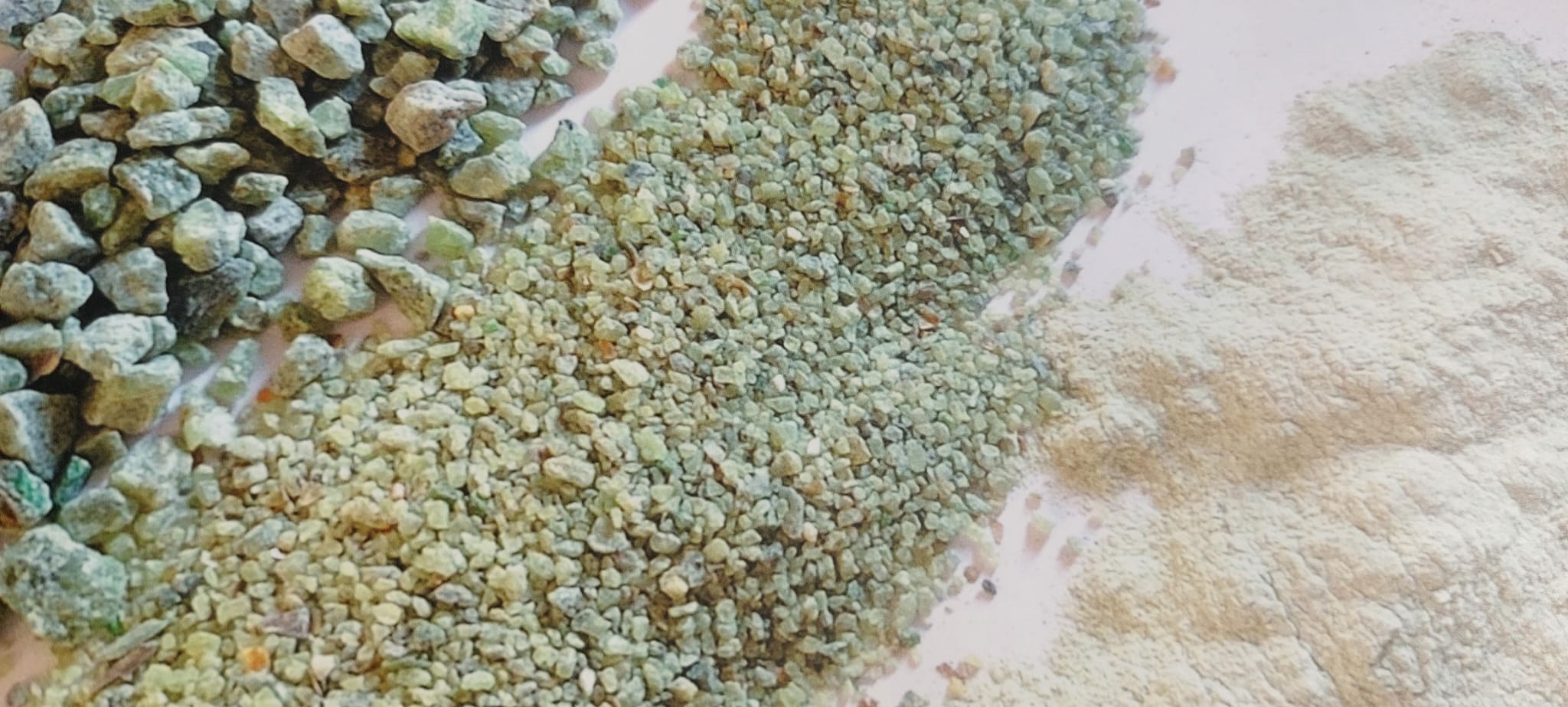
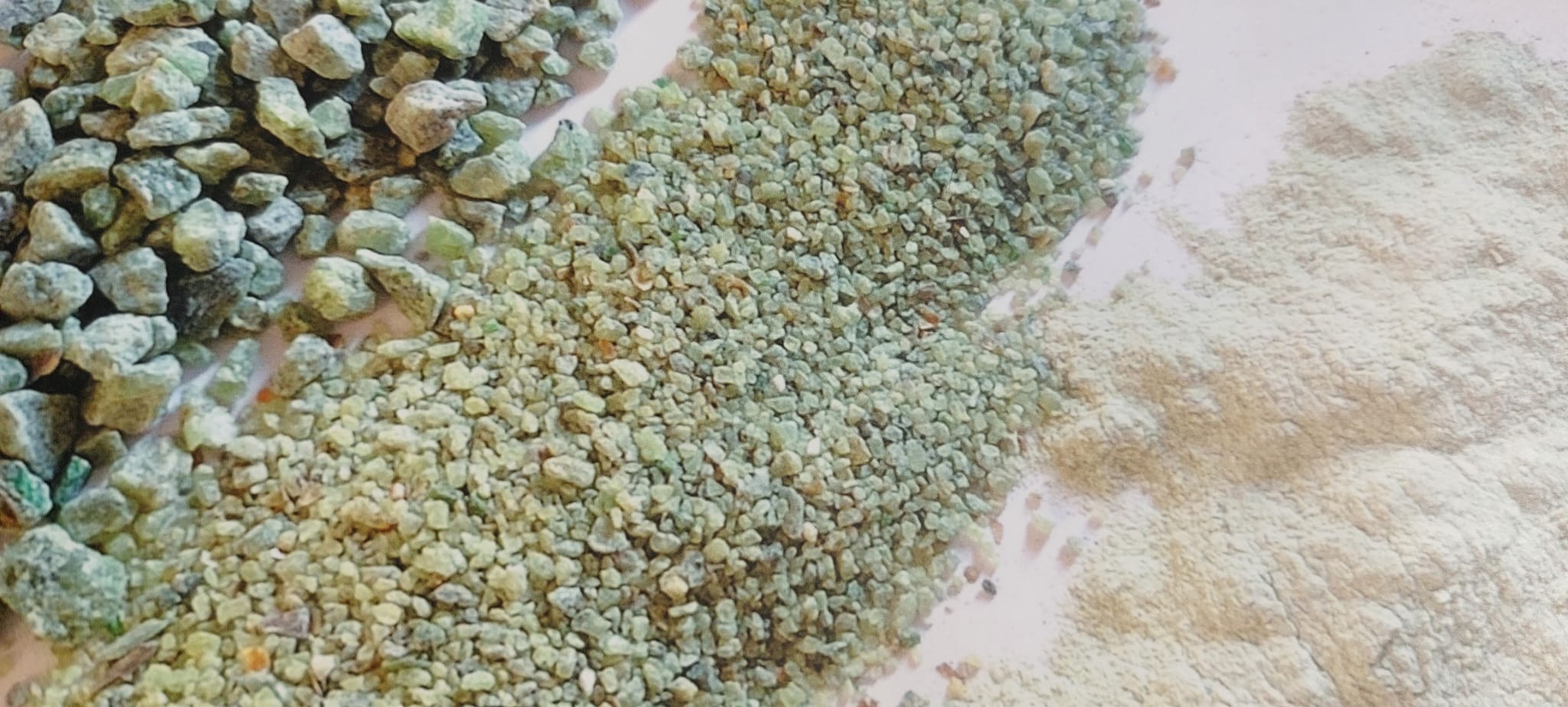
Olivine is a naturally occurring mineral composed mainly of magnesium and iron silicates. According to the safety documentation associated with the product, the declared mineralogical composition contains at least 90% olivine. The material consists of grey-green grains with an angular, irregular shape and is insoluble in water, non-flammable and non-explosive.
These characteristics make it suitable for use as a blasting abrasive. Accelerated by the airflow, the grains strike the surface and contribute to removing loose or adhering layers. The result depends on jet energy, distance, angle of impact, travel speed and the resistance of the material being treated.
Why grain shape matters
An angular grain produces a different action from a rounded glass bead. Sharp edges promote a cutting effect that is useful when the objective is to remove oxidation, coatings or residues and create a surface suitable for subsequent treatment. Shape alone does not determine aggressiveness: particle size, hardness, pressure and airflow remain interdependent parameters.
S2 particle size from 0.1 to 0.5 mm
Particle size describes the dimensional range of the abrasive grains. OLYBLAST S2 covers the 0.1–0.5 mm range. Before use, it is necessary to verify that the particle size is compatible with the abrasive passage, metering device, valve, hose and nozzle of the blasting machine. Damp, contaminated or agglomerated material can compromise flow consistency even when the nominal particle size is correct.
The benefits of OLYBLAST
No detected free crystalline silica
The documentation reports quartz, tridymite and cristobalite as not detected. This is an important consideration for users seeking to replace traditional silica sand with an abrasive more suited to professional use. Communication must, however, remain precise: the absence of free crystalline silica does not eliminate dust generation or the need to apply the required preventive measures.
Abrasive performance and uniform action
The angular structure of the grains makes OLYBLAST effective for removing oxidation, paints and contaminants compatible with the process. Its particle-size distribution creates a jet made up of particles of different sizes, which must be controlled through pressure, airflow and abrasive metering.
Natural mineral origin
OLYBLAST is not produced from industrial slag or metallic residues: it is a natural mineral material. The safety data sheet describes it as inert and chemically stable; uncontaminated product is considered a non-metallic inert mineral for disposal purposes, although it must still be managed in accordance with applicable regulations and taking into account substances removed during blasting.
Application versatility
A single abrasive can be considered for operations on metal, concrete and wood by adjusting the parameters according to the substrate. This versatility is useful for workshops, construction companies, maintenance operators and users carrying out different types of work who want to reduce the number of abrasive products kept in stock.
An alternative to compare with premium abrasives: FEVI offers OLYBLAST as a competitive alternative to higher-end mineral abrasives such as garnet. A proper comparison should not be based only on price per kilogram or litre: actual consumption, removal speed, finish quality, potential for reuse, nozzle wear and collection and disposal costs must also be measured.
Which materials can it be used on?
Iron and steel: On metal components, fabricated structures and assemblies, OLYBLAST can be considered for removing rust, oxidation, old paint and residues or for preparing the surface before a protective coating cycle. Thin materials, sheet metal and precision components require carefully controlled pressure and exposure time to avoid deformation or an excessive surface profile.
Concrete, stone and brick: In construction applications, blasting abrasive can be used to remove coatings, adhering dirt, residues and loose surface material. Porosity, hardness and condition vary considerably: before extending treatment to the entire surface, a test must be carried out on a representative area and the effect on the substrate assessed.
Wood: On wood, OLYBLAST can be used to remove paint or highlight the grain, but adjustment must be more cautious than on metal. Wood species, moisture content, knots and the condition of the component influence the response. Excessive pressure can erode softer areas and create an unwanted raised grain effect.
Automotive and marine sectors: Body shops, workshops, boatyards and maintenance companies can use an olivine-based blasting abrasive on compatible components and structures. Bearings, seals, machined parts, systems, glass and areas that must not be exposed to the jet must be protected before treatment.
How to choose the right blasting abrasive
The selection process should follow an organised assessment:
- identify the base material and its thickness;
- define what must be removed and the required degree of removal;
- establish the finish or surface profile required by the subsequent coating cycle;
- check the type of blasting machine, metering device, hose and nozzle diameter;
- check compressed-air flow and quality;
- consider containment, recovery, extraction and disposal;
- carry out a test on a representative sample;
- record the pressure, distance, angle and travel speed that produced the required result.
Particle size alone cannot predict the outcome of the process. Two surfaces made from the same material may respond differently because of hardness, oxidation, coating thickness and geometry. An initial test turns a theoretical choice into a verified operating parameter.
OLYBLAST compared with other abrasives
| Type | Primary action | When to consider it | Aspect to check |
|---|---|---|---|
| OLYBLAST olivine-based abrasive | Abrasion with angular mineral grains | Versatile operations on metal, concrete and wood | Operating parameters, machine compatibility and testing on the substrate |
| Corundum | Generally more intensive abrasive action | Demanding removal operations and pronounced surface profiles | Aggressiveness, equipment wear and process cost |
| Crushed glass abrasive | Controlled action with angular grains | Applications requiring a balance between removal and finish | Compatibility with the material and required aesthetic result |
| Glass beads | Action focused more on finishing and light bead blasting | Uniforming, satin finishing or surface finishing | Limited effectiveness on strongly adhering coatings |
| Vegetable abrasive | Gentle treatment | Sensitive components and materials | Removal capacity and management of organic residues |
This table provides general guidance and does not replace testing. Hardness, particle size and shape can also vary within the same abrasive family. FEVI can verify the most suitable configuration based on the component, the available blasting machine and the required result.
Safety: ecological does not mean working without protection
The OLYBLAST safety data sheet states that repeated and prolonged overexposure to significant quantities of dust can irritate the respiratory tract and may have adverse health effects. Dust can also cause mechanical irritation to the eyes. Occupational exposure limits must therefore be respected and respiratory, eye and other required PPE must be used whenever operating conditions require them.
The final residue does not consist only of olivine. After use, the abrasive may contain paint, metals, oils, contaminants or other substances removed during the process. Classification and disposal must therefore take into account the mixture actually collected, not only the characteristics of the unused product.
How to use OLYBLAST correctly
Keep the material dry
Moisture encourages agglomeration and can make abrasive metering inconsistent. The container should be closed after use and stored in a dry place protected from water ingress and condensation. The compressed air must also be adequately treated.
Adjust abrasive metering
Feeding more abrasive does not automatically mean faster blasting. Excessive abrasive flow can slow the stream, increase consumption and make the jet less efficient. Correct adjustment is identified by a continuous flow and consistent removal verified on the surface.
Check the nozzle and wear components
Nozzle wear progressively increases its diameter and changes the required airflow. A compressed-air line that originally worked correctly may become insufficient over time. Periodic checks of the nozzle, abrasive hose, fittings and metering device help maintain process repeatability.
Validate pressure on the actual component
Pressure must be sufficient to achieve the required removal without damaging the substrate. It is preferable to start with a conservative setting and increase it progressively while maintaining a consistent distance and travel speed. Compressor pressure does not necessarily correspond to the actual nozzle pressure because of line losses.
Mistakes to avoid when selecting blasting abrasive
- using ordinary silica sand without considering the risks associated with free crystalline silica;
- selecting the abrasive solely on the basis of package price;
- ignoring particle-size compatibility with the valve, hose and nozzle;
- using damp or contaminated material;
- overfeeding abrasive in the belief that this will automatically increase productivity;
- starting treatment without testing a representative area;
- working without adequate containment, extraction or operator protection;
- reusing abrasive without separating dust, fragments and contaminants;
- disposing of used abrasive as if it were new and uncontaminated material.
OLYBLAST S2 – Olivine-based sandblasting abrasive (0.1–0.5 mm)
The S2 0.1–0.5 mm version is available on the FEVI Store in a 13-litre container. To check the required quantity, compatibility with the blasting machine and initial operating parameters, a FEVI technical assessment can be requested.
Frequently asked questions about sandblasting abrasive and OLYBLAST
Which sand should be used in a blasting machine?
A specific blasting abrasive should be used, selected according to the machine, nozzle diameter, surface and required result. Ordinary sand is not recommended. OLYBLAST is a natural olivine-based mineral abrasive offered in the S2 version with a particle size of 0.1–0.5 mm.
Does OLYBLAST contain free crystalline silica?
The safety documentation reports quartz, tridymite and cristobalite as not detected. This characteristic makes OLYBLAST an alternative to traditional silica sand. Exposure to dust generated during blasting must still be controlled.
Does OLYBLAST produce no dust?
No. Any abrasive process can generate dust both from particle fragmentation and from removal of material from the surface. Suitable containment, ventilation or extraction and PPE defined according to the operation are required.
What is the particle size of OLYBLAST S2?
The stated particle-size range is 0.1 to 0.5 mm. Suitability must be checked in relation to the metering system, hose, nozzle and type of blasting machine. Moisture can compromise flow even when the particle size is otherwise compatible.
Can it be used for blasting iron?
Yes. OLYBLAST can be considered for removing rust, oxidation and paint from iron and steel. Pressure, distance and travel speed must be tested on the component, particularly when working with thin sheet metal or precision components.
Is it suitable for blasting wood?
It can be used on wood with conservative operating parameters. Soft woods, deteriorated areas and differences in grain can be eroded unevenly. A preliminary test and progressive pressure adjustment are essential.
Can it be used on concrete?
Yes. FEVI includes concrete among the materials that can be treated. The result depends on strength, porosity, the coating being removed and the condition of the substrate. A representative area should be tested before treating the entire surface.
Is it compatible with every blasting machine?
Universal compatibility should not be assumed. The abrasive metering system, internal passages, nozzle diameter, airflow and operating method must all be checked. FEVI can verify the configuration based on the machine model and application.
Can the abrasive be recovered and reused?
Reuse depends on grain fragmentation, the recovery system, dust content and collected contamination. Before the material is recirculated, fine fractions must be separated and the remaining particle size and abrasive performance checked.
How should used blasting abrasive be disposed of?
New, uncontaminated product is described as a non-metallic inert mineral. After use, however, the residue also contains the material removed from the surface. Disposal must therefore be determined according to the actual contamination and applicable regulations.
Where can I buy OLYBLAST?
The S2 0.1–0.5 mm version is available on the FEVI Store in a 13-litre container. To check quantities, compatibility with the blasting machine and initial operating parameters, a FEVI technical assessment can be requested.
Final technical considerations: measuring the actual cost per square metre
The package price is not the most useful figure when comparing two abrasives. For a professional assessment, it is preferable to carry out a test on a sample surface and record five indicators: quantity consumed, processing time, degree of removal, surface profile achieved and nozzle wear. Dividing consumption and processing time by the number of square metres treated provides a comparison that is much closer to the actual process cost.
A second useful practice is to retain a small quantity of unused abrasive and compare it with material recovered after one or more cycles. Visual or particle-size comparison helps determine how much the grains have fragmented and when the proportion of fines begins to reduce efficiency and visibility. This simple check makes it possible to establish more consistent replacement criteria than relying on a fixed number of reuse cycles.
Finally, when the surface is to receive paint or another coating, the result should not be judged only visually. The preparation grade and surface profile must comply with the recommendations of the protective coating manufacturer. In this way, OLYBLAST becomes part of a measurable and repeatable process rather than simply a consumable material.
Ask FEVI for the blasting abrasive suitable for your application
To assess OLYBLAST, provide FEVI with the model of the blasting machine, nozzle diameter, material to be treated, residue to be removed and required finish. Photographs of the component and information about the surface to be treated make it possible to verify compatibility more quickly and define suitable starting parameters for a test.